Two plumbers can do the same job at the same price. One gets the call, and the other gets skipped. Often the difference isn't the work. It's how each business looks, sounds, and feels before the customer ever picks up the phone. So what is branding, exactly?
Branding is everything that shapes how people see your business: your name, logo, colours, and fonts, but also the way you talk, the promises you make, and the experience customers have when they deal with you. Your brand is the reputation that forms in customers' minds. Branding is the work you do to shape it.
This guide explains what a brand includes, why branding matters for business, how to build or tidy up your brand step by step, and how to protect it in Australia.
Key takeaways
- A brand is more than a logo. It's your visual identity, your voice, your promise, and the experience customers have.
- Branding for business wins work by making you recognisable, trusted, and easy to choose over a competitor.
- Consistency matters most. The same look and message on your website, vehicles, quotes, and social media builds recognition.
- Protect what you build. A registered business name doesn't give you exclusive rights; a trade mark does.
Branding, brand identity, and logo: what's the difference?
People use these words as if they mean the same thing. They don't, and the difference helps you spend money in the right place.
Brand, brand identity, and logo
Three words that often get mixed up
| Term | What it means | Example |
|---|---|---|
| Brand | How people see and feel about your business | "Reliable, on time, and tidy" |
| Brand identity | The visual and verbal tools that express the brand | Logo, colours, fonts, tone of voice |
| Logo | The symbol or wordmark that identifies you | The mark on your van and invoices |
A logo is one part of your brand identity, and your brand identity is one part of your brand. A great logo can't fix a business that's late, rude, or inconsistent. A strong brand needs all three working together.
What a brand includes

A complete brand has a few parts. Most established businesses already have some of them, even if nobody wrote them down.
Visual identity
Visual identity is the look of your brand: your logo, colour palette, fonts, and the style of your photos and graphics. It should work everywhere you appear, from a website header to a shirt embroidery to a tiny social media icon.
A brand kit like the example above sets the rules: which logo to use where, the exact colours, the fonts for headings and body text, and how not to use the logo.
Brand voice
Your brand voice is how your business sounds in writing and in person: on your website, in quotes, in emails, and on the phone. A builder might sound practical and straight talking. A dental clinic might sound calm and reassuring. Whatever you choose, keep it the same everywhere.
Brand promise and values
Your brand promise is what customers can count on every time they deal with you, like "on time, or we call ahead" or "a fixed price before we start". Your values are the beliefs that guide how you work. Together, they're what people repeat when they recommend you.
Customer experience
Every interaction is part of your brand: how fast you answer an enquiry, how clear your quote is, how tidy the site is when you leave, and how you handle a complaint. For service businesses, this is often the strongest part of the brand.
Why branding matters for business
Branding isn't just for big companies with big budgets. For an established local business, it does three practical jobs.
- It makes you recognisable. When customers see the same logo, colours, and message on your van, your website, and your Google Business Profile, they remember you.
- It builds trust before the first call. A professional, consistent brand signals that you're established and reliable. 97% of consumers read reviews for local businesses, according to BrightLocal's local consumer review survey, so your reputation is part of your brand too.
- It makes you easier to choose. When two businesses look similar on price, the clearer, more trusted brand usually wins the job, and can often charge a little more.
For example, a builder whose vans, site signs, and website all carry the same logo and colours is far easier to remember than one with a different look in each place. When a neighbour later needs a builder, that recognition is the brand doing its job.
How to build or refresh your brand
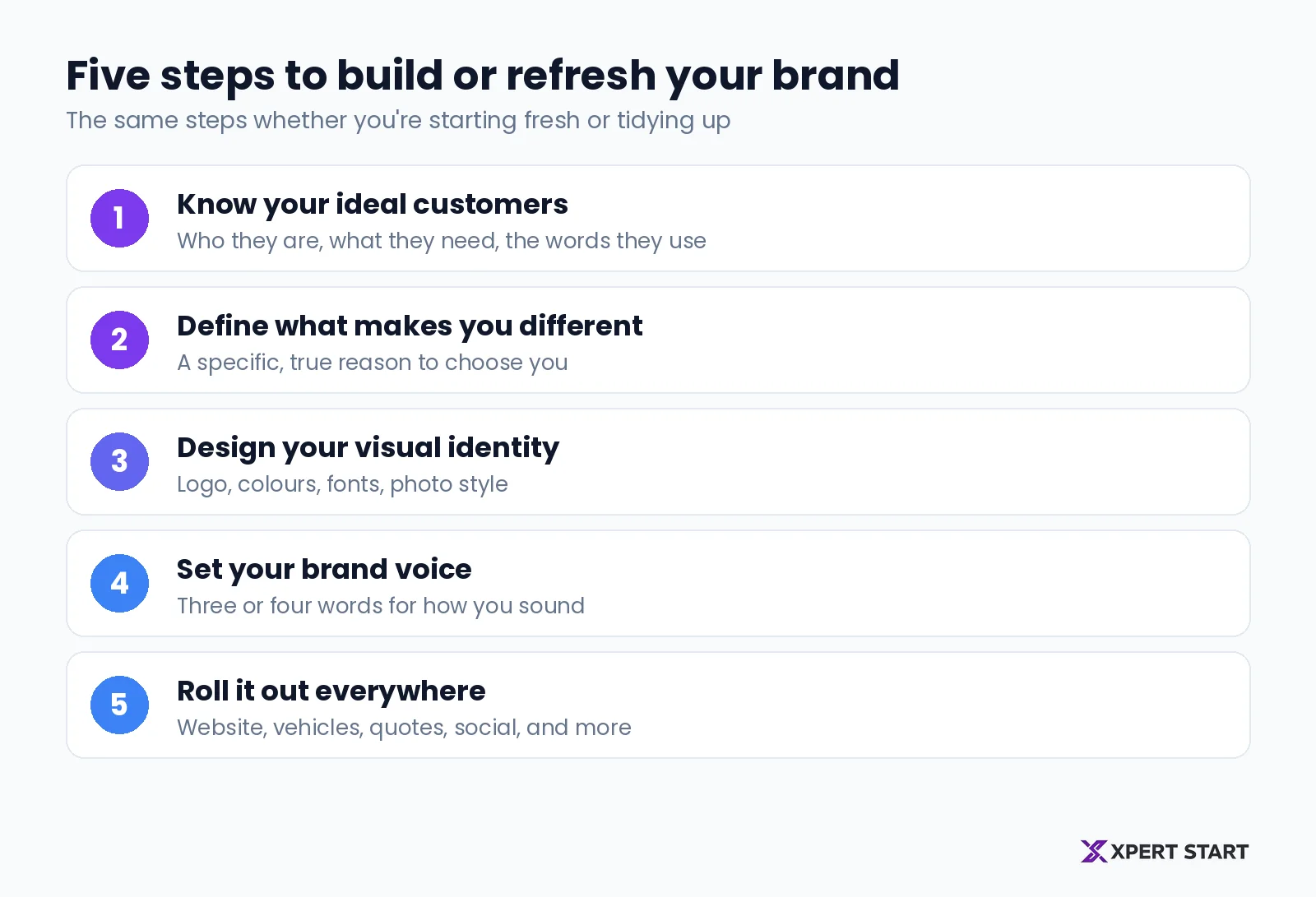
Whether you're building a brand properly for the first time or tidying up years of mismatched logos, the steps are the same.
Step 1: Know your ideal customers
Write down who your best customers are, what they need, and what worries them when they hire someone like you. Talk to a few of them, read your reviews, and note the words they use. A brand that speaks to everyone usually speaks to no one.
Step 2: Define what makes you different
A unique value proposition is a short statement of why customers should choose you over the alternatives. It should be specific and true. "Quality service" isn't a difference. "Licensed electricians who quote a fixed price before starting" is.
Step 3: Design your visual identity
Work with a designer on your logo, colours, and fonts, and ask for versions that work in colour, in black and white, and at small sizes. Our guide to logo design trends shows what's working for Australian businesses now.
Step 4: Set your brand voice
Choose three or four words that describe how you sound, like "friendly, practical, and clear", and write a few examples of what that looks like in a quote, an email, and a social post. Share them with anyone who writes for the business.
Step 5: Roll it out everywhere
Update every place customers see you: website, Google Business Profile, vehicles, uniforms, quotes and invoices, email signatures, and social media. Business.gov.au's guide to refreshing your business brand makes the same point: a rebrand is more than a new logo, and if your name changes, you'll also need to update your business registration, ABN, domain name, and trade marks.
Where your brand shows up
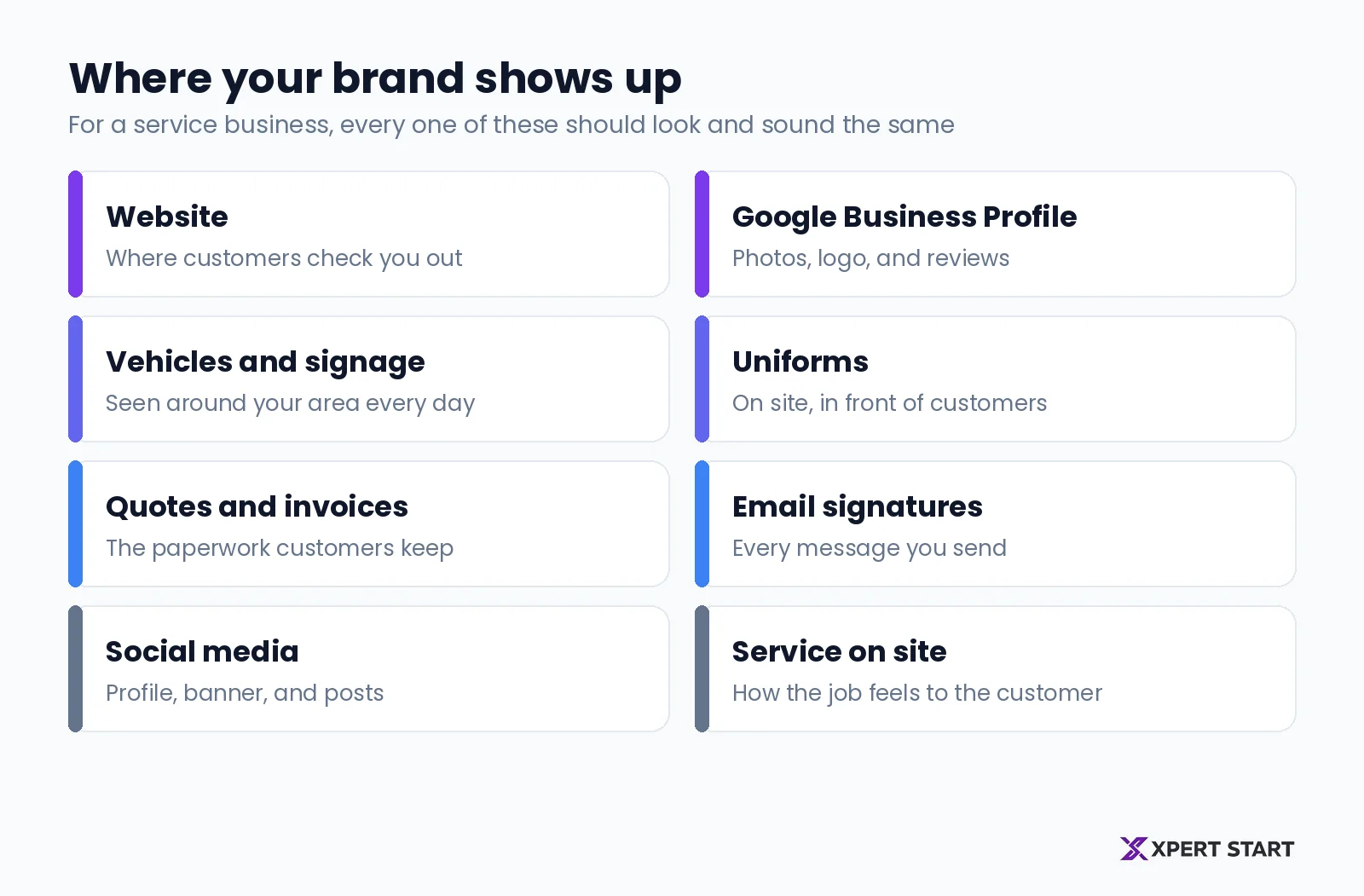
For a service business, the website is usually the most important place your brand lives, because it's where customers check you out before calling. A website built around your brand, with your colours, voice, and real photos, makes every other part of your marketing work harder. Our Webflow web design team builds sites that carry your brand through every page.
Protect your brand in Australia
Many owners assume a registered business name protects their brand. It doesn't. Business.gov.au explains the difference between a business name and a trade mark: registering a business name doesn't give you exclusive rights to it, while a registered trade mark gives you exclusive rights in Australia. A trade mark can protect a word, phrase, logo, and more.
Before you invest in a new name or logo, check that nobody else already uses something similar, then talk to IP Australia or an IP adviser about registering it.
Common branding mistakes
- Treating the logo as the whole brand. A new logo on a business that still answers the phone late doesn't change much.
- Inconsistency. Three versions of your logo, different colours on the van and website, and a different tone on every page.
- Copying competitors. If you look like everyone else, customers choose on price.
- No brand guidelines. Without a simple guide, every new sign or social post drifts further from the original.
- Ignoring reviews. Your reputation is part of your brand, so reply to reviews and fix what they point out.
- Never reviewing it. Check your brand every few years, or when your services, customers, or market change.
Frequently asked questions
What is branding in simple terms?
Branding is the work you do to shape how people see your business. It covers your name, logo, colours, and fonts, plus how you talk, what you promise, and the experience customers have with you.
What's the difference between a brand and a logo?
A logo is the symbol or wordmark that identifies your business. A brand is the overall impression people have of you, built from your logo, your voice, your service, and your reputation.
Why is branding important for a business?
Branding makes you recognisable, builds trust before the first contact, and makes you easier to choose over competitors. A strong brand can also help you charge fairly for your work instead of competing on price alone.
How often should a business review its brand?
Review it every few years, and whenever your services, target customers, or market change. A refresh can be as simple as tidying up your logo and colours, rather than starting again.
How much does branding cost?
It depends on what you need. A logo on its own costs less than a full brand identity with guidelines, templates, and signage files. Our guide to what branding services include explains each level.
The bottom line
Branding is how your business looks, sounds, and behaves every time a customer meets it. Get clear on who you serve and what makes you different, build a visual identity and voice that express it, use them consistently everywhere, and protect them with a trade mark.
If your brand has drifted, or never quite matched the business you've built, our branding services and logo design can help, and you can see examples in our portfolio. Book your free digital audit to see how your brand comes across online, or read about us.