Opening a new business, a second location, or a new brand comes with a long list of jobs. The registrations get done because they have to. The digital setup often gets rushed in the last week: a logo made in an evening, an email address on a free account, and a website that says "coming soon" on opening day.
Here's the short answer for this business launch checklist. Secure your business name, domain, and social handles together. Set up business email on your own domain. Get a logo and simple brand kit, then build a website that turns visitors into enquiries. Finally, claim your Google Business Profile and list the business in the directories your customers use, so you can be found from day one.
This guide covers each step in order, what it costs, and the mistakes that cost new businesses the most time and money.
Business launch checklist
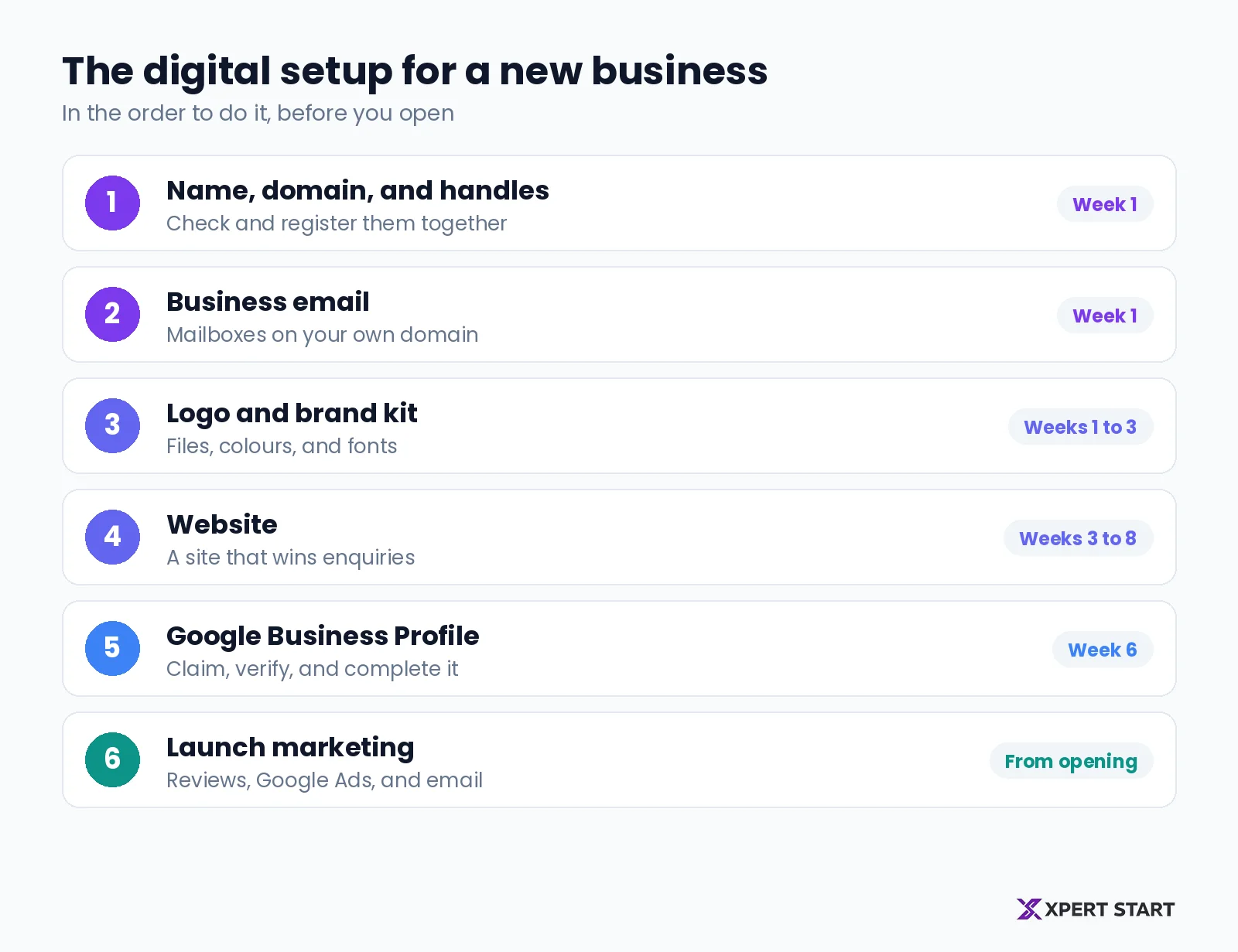
The digital setup, in the order to do it
| Step | What to do | Typical cost |
|---|---|---|
| Name and domain | Check the name, register the domain and social handles | $15 to $30 a year for a .com.au |
| Business email | Mailboxes on your own domain | From about $10 per user a month |
| Logo and brand kit | Logo files, colours, and fonts | Varies with scope |
| Website | A site that wins enquiries | $4,000 to $8,000 for five pages |
| Google Business Profile | Claim and complete your listing | Free |
| Launch marketing | Reviews, Google Ads, and email | Your time, plus ad spend |
Step 1: Lock in your name, domain, and handles together
Before you print anything, check that the name is available everywhere you'll use it.
- Register the business name with ASIC, after checking it isn't already taken. Business.gov.au's starting a business checklist covers the ABN, GST, and business name steps.
- Check trade marks. A registered business name doesn't give you exclusive rights to it. Business.gov.au explains the difference between a business name and a trade mark.
- Register the domain on the same day. A .com.au needs an ABN, and short, clear names go quickly.
- Claim social handles on the platforms your customers use, even if you won't post straight away.
A domain name is your address on the internet, like yourbusiness.com.au. Register it in the business's name, not your web designer's, so you always control it.
Step 2: Set up business email on your own domain
An address like you@yourbusiness.com.au looks established on quotes and invoices, and it's far less likely to land in spam than a free address. Google Workspace and Microsoft 365 both start at about $10 per user a month.
Set up the DNS records that prove your email is genuine before you send your first quote. Our business email setup guide walks through Gmail and Outlook step by step, including SPF, DKIM, and DMARC.
Step 3: Get a logo and a simple brand kit
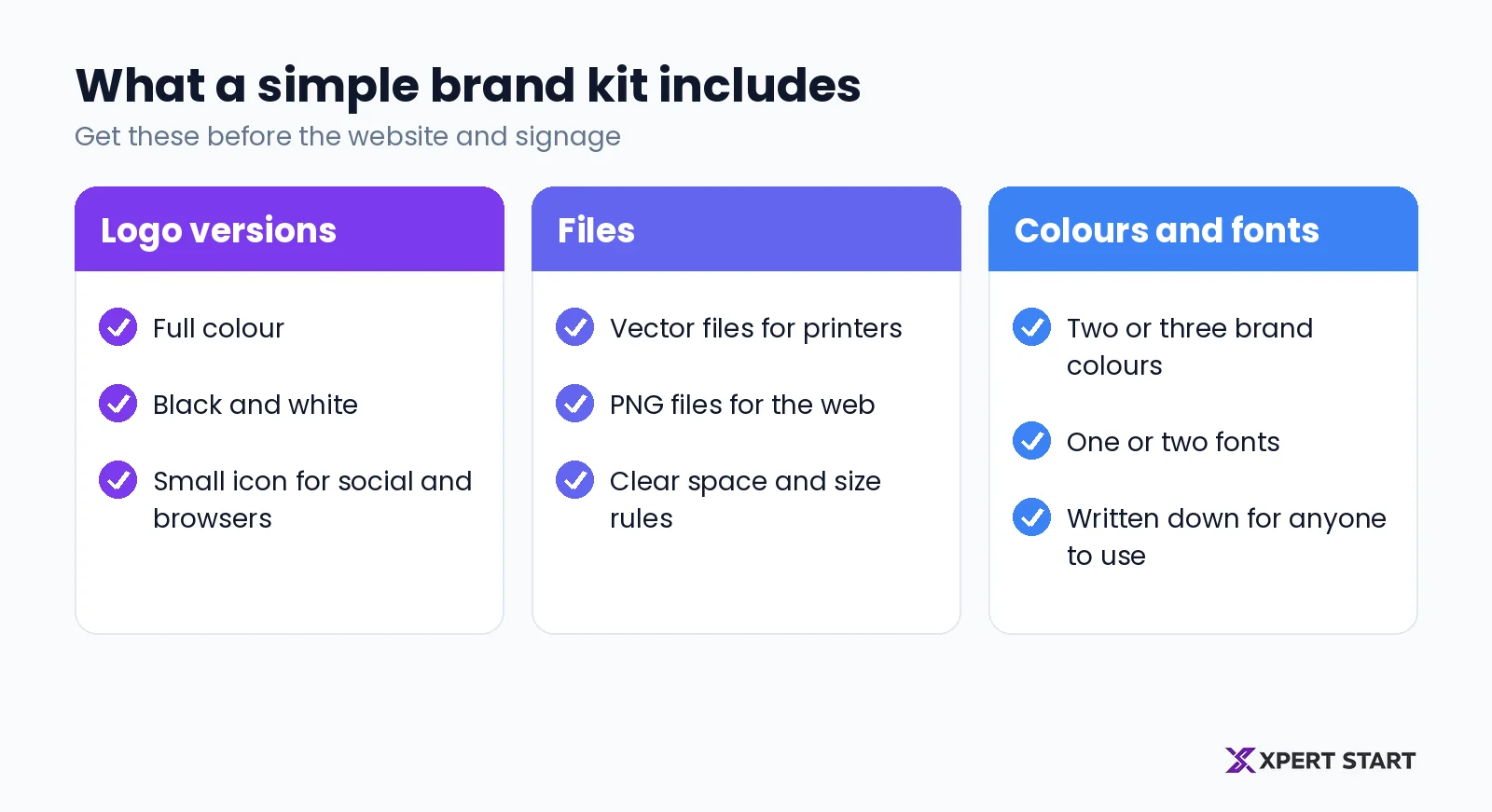
A brand kit is a short set of rules for your logo, colours, and fonts, so every sign, uniform, and social post looks the same. You need it before the website, because the website is built around it.
- Ask for your logo in colour, black, and white, and as a small icon for social media and browser tabs.
- Get the files in the formats printers and web designers need (vector and PNG).
- Choose two or three colours and one or two fonts, and write them down.
Our guide to what branding is explains what a brand includes beyond the logo, and our logo design service covers the files and kit.
Step 4: Build a website that wins enquiries
A website is often the first place customers check you out, even when a friend recommends you. For a new business, it has three jobs: explain what you do, show why customers can trust you, and make it easy to contact you.
- A clear headline that says what you do and where.
- A page for each main service.
- Contact details and a short enquiry form on every page.
- Fast loading and an easy layout on phones.
For example, a new electrician's site with a services page, a service area, licence details, and a call button can win work in the first week. Most five page business websites cost $4,000 to $8,000. Our guide to website cost in Australia breaks down what's included at each price.
Step 5: Get found on Google and in directories
A Google Business Profile is your free listing on Google Search and Maps. Claim it as soon as you have an address or service area, because verification can take time. Google's guide to how local results are ranked names relevance, distance, and prominence.
- Complete every section: category, services, hours, service area, and photos.
- Use the same business name, address, and phone number everywhere.
- List the business in the directories your industry uses, like trade or health directories.
Our local SEO guide covers the profile and listings step by step.
Step 6: Plan your launch marketing
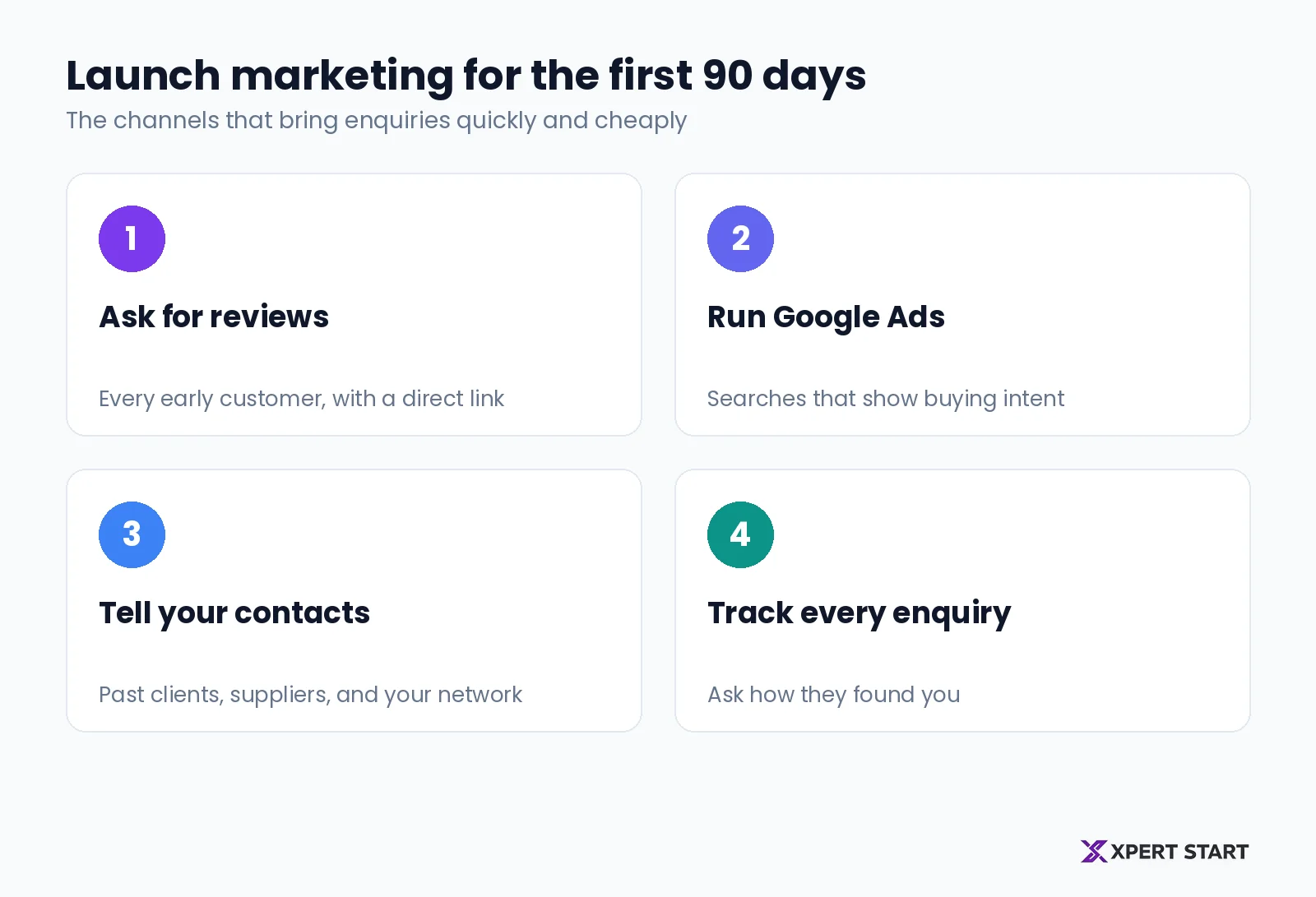
The first few months set the pace. Focus on the channels that bring enquiries quickly and cheaply:
- Reviews. Ask every early customer for a Google review. A new profile with a few genuine reviews beats one with none.
- Google Ads. Ads can bring enquiries within days while your site builds up search rankings. Our management starts at $750 setup plus $1,000 a month, including GST.
- Your existing contacts. Tell past clients, suppliers, and your network, with permission to email them.
- Tracking. Ask every enquiry how they found you, so you know what to keep paying for.
Our guide on how to get more leads covers what to do once the enquiries start.
Common business launch mistakes
- Registering the domain in someone else's name. If you fall out with your web designer, you can lose it.
- Using a free email address. It looks temporary and lands in spam more often.
- A logo with no files. You'll pay again when the sign writer asks for a vector file.
- A "coming soon" page on opening day. Customers who check you out find nothing.
- Leaving the Google Business Profile until later. Verification takes time, and you miss early map searches.
- Not tracking enquiries. Without it, you can't tell which launch spend worked.
Frequently asked questions
What should be on a business launch checklist?
The registrations (ABN, business name, GST if needed, and licences), then the digital setup: domain, business email, logo and brand kit, website, Google Business Profile, and a plan for your first marketing. Business.gov.au's checklist covers the registrations.
What does a business launch service include?
It usually covers the digital setup a new business needs in one go: logo and branding, a website, business email, and the Google Business Profile, sometimes with launch marketing. Bundling them keeps the look and the timing consistent.
How much does it cost to set up a new business online?
Expect $15 to $30 a year for a .com.au domain, about $10 per user a month for business email, and $4,000 to $8,000 for a professional five page website. Logo and branding costs vary with scope.
How long before launch should I start on the website?
Start six to eight weeks before you open. A five page site usually takes three to five weeks to build, and you'll want time to write the content and test it.
Do I need a website if I have social media?
Yes. A website ranks in Google for your services, shows your licences and reviews in one place, and belongs to you, while social platforms can change their rules at any time.
The bottom line
A good business launch has the digital setup ready before the doors open: the name and domain locked in, email on your own domain, a logo with a simple brand kit, a website that wins enquiries, and a complete Google Business Profile. Then ask early customers for reviews and track where every enquiry comes from.
If you'd like it handled in one go, our business launch services bring the branding, website, and email together. Book your free digital audit, see our Webflow web design, or read about us.