Your competitors aren't necessarily better than you. They're just easier to find. When someone nearby searches "plumber near me" or "physio Parramatta", Google shows a map with three businesses. If you're not one of them, most of those customers never see you.
Here's the short answer. Local SEO for a small business in Australia comes down to four things:
- A complete and accurate Google Business Profile.
- A steady flow of genuine reviews.
- Consistent listings across the web.
- Website pages that match the services and areas you cover.
This guide explains how Google ranks local results, then walks through each step in the order we tackle it for clients. It finishes with a 12 week plan you can follow.
Updated for 2026.
How Google ranks local results
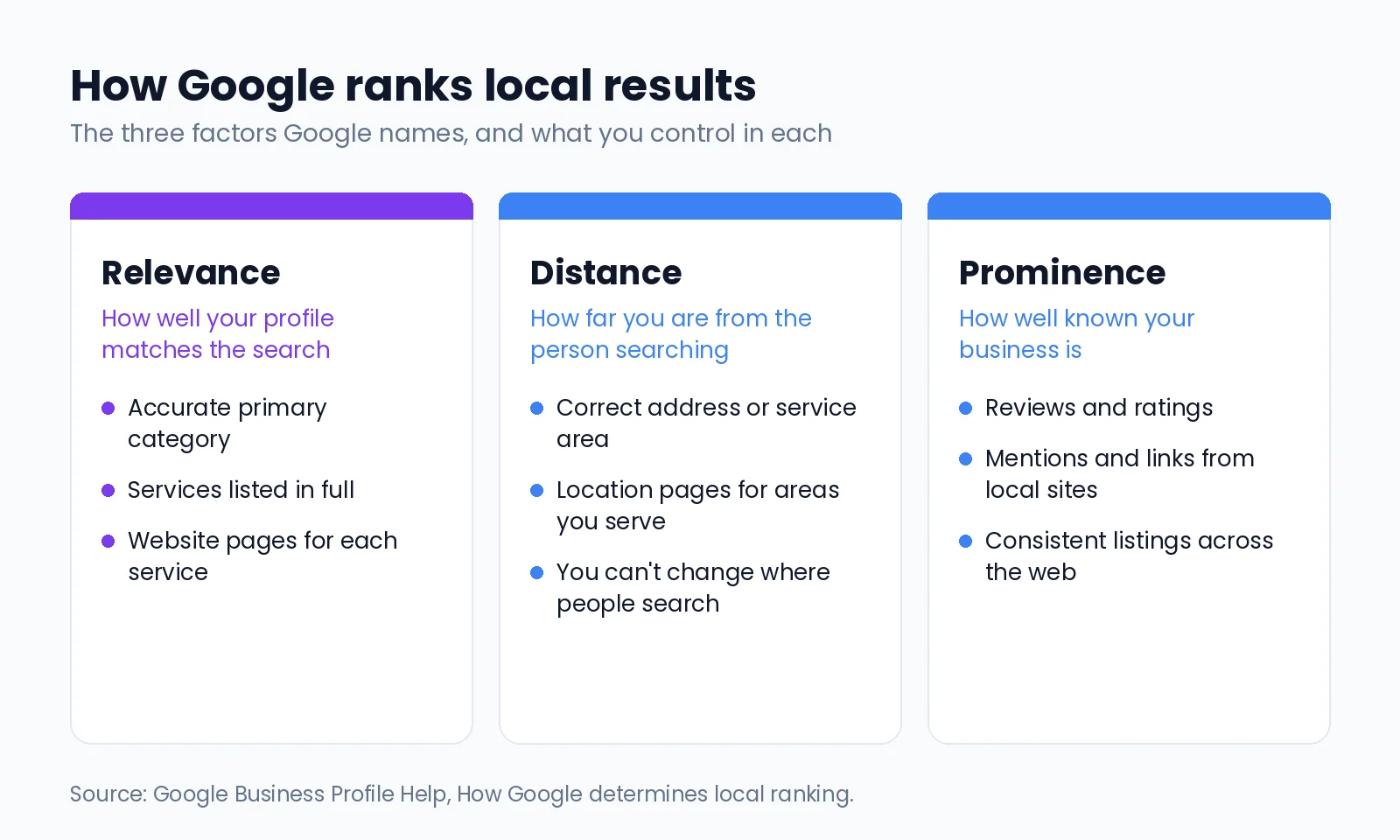
Local SEO is the work of making your business show up when people search for what you do in your area. Google is unusually open about how it ranks local results. Its guide to local ranking names three factors:
- Relevance: how well your Business Profile matches what someone is searching for.
- Distance: how far your business is from the person searching.
- Prominence: how well known your business is, both online and offline.
Google also says there's no way to request or pay for a better local ranking. That rules out every "guaranteed map pack" offer you'll get by email.
You can't move your premises closer to every customer. But you can control relevance and prominence, and that's where local SEO effort goes.
Step 1: Set up your Google Business Profile properly
A Google Business Profile is the free listing that appears in Google Maps and the map results in search. For most local businesses, it brings in more calls than the website does.
Get these right first:
- Business name. Use your real business name, exactly as it appears on your signage and invoices. Google's Business Profile guidelines don't allow extra keywords in the name, and keyword stuffing can get a profile suspended.
- Primary category. Choose the most specific category that describes your core business. Google's guidelines say to use as few categories as possible.
- Address or service area. Show your address if customers visit you. If you travel to customers, set a service area and hide the address.
- Hours. Keep regular and holiday hours accurate. Wrong hours lose trust fast.
- Services and description. List every service you offer, in the words customers use.
- Photos. Add real photos of your team, your work, your vehicles, and your premises. Stock photos do nothing for you.
Then keep it active. Post updates, add new photos of recent jobs, and answer questions customers ask on the profile.
Step 2: Build a steady flow of genuine reviews
Reviews are the part of local SEO customers notice most. Google says more reviews and positive ratings can help your local ranking, and they also decide who gets the call.
BrightLocal's local consumer review survey of US consumers shows how much reviews shape choices:
- 97% of consumers read reviews for local businesses.
- 74% look for reviews written in the last three months.
- 47% won't use a business with fewer than 20 reviews.
- 80% are likely to use a business that responds to all of its reviews.
The survey is American, but the habits are familiar to anyone who checks Google before calling a tradie.
How to get more reviews without being pushy:
- Ask in person at the end of a job, when the customer is happiest.
- Follow up with a text that includes your direct review link.
- Put a QR code on invoices, quotes, and your counter.
- Reply to every review, good and bad, within a few days.
Never buy reviews or offer discounts in exchange for them. It breaks Google's rules and can get reviews removed. For health practices, our guide to clinic marketing covers the Ahpra advertising rules that apply to reviews.
Step 3: Make your listings consistent
NAP means your business name, address, and phone number. Google checks these details across the web, so they should match everywhere.
For instance, a plumber who moved premises often still has the old address on several directories. Start with the listings that matter most in Australia:
- Apple Maps and Bing Places, which feed other apps and devices.
- Yellow Pages and True Local.
- Industry directories, such as hipages or Oneflare for trades and HotDoc for clinics.
- Your Facebook page and any industry association listings.
While you're there, look for duplicate or outdated listings, such as an old address or a previous phone number. Claim and fix them, or ask for them to be removed. One accurate listing is worth more than five messy ones.
Step 4: Build local pages on your website

Your Google Business Profile links to your website, and Google reads both. Your site should make it obvious what you do and where.
- One page per core service. "Blocked drains" and "hot water repairs" deserve their own pages, not one line on a services list.
- A strong city or region page. For example, "Plumber Western Sydney", covering your whole service area and linking to the suburb pages.
- Suburb pages only where you have real local proof. Each one needs jobs, photos, and reviews from that suburb. Ten near identical suburb pages with the name swapped can hurt more than they help.
- Your NAP in the footer and a map on your contact page.
Behind the scenes, a technically sound site helps Google trust it. Our technical SEO audit guide covers the checks, and Google's guide to local business structured data explains how to mark up your address and hours.
Step 5: Use the words your customers use
Local searches are short and practical: "electrician near me", "emergency plumber Penrith", "physio open Saturday". Your pages and profile should use the same plain language.
- Use Australian terms, like "tradie", "ute", and "strata", where your customers would.
- Answer common questions on your service pages in two or three short sentences.
- Mention the suburbs and landmarks you actually work around.
Our guide to keyword strategy for established businesses shows how to find the searches that bring in work, not just traffic.
Step 6: Measure what matters
Rankings are a means to an end. Track the actions that turn into revenue:
- Calls, website clicks, and direction requests from your Google Business Profile performance report.
- Enquiries and bookings from your website, tracked in Google Analytics.
- Which searches show your profile, also in the performance report.
A simple way to judge local SEO is to multiply new calls by your average job value. If local SEO brings in five extra jobs a month at $600 each, that's $3,000 a month of work.
Your 12 week local SEO plan
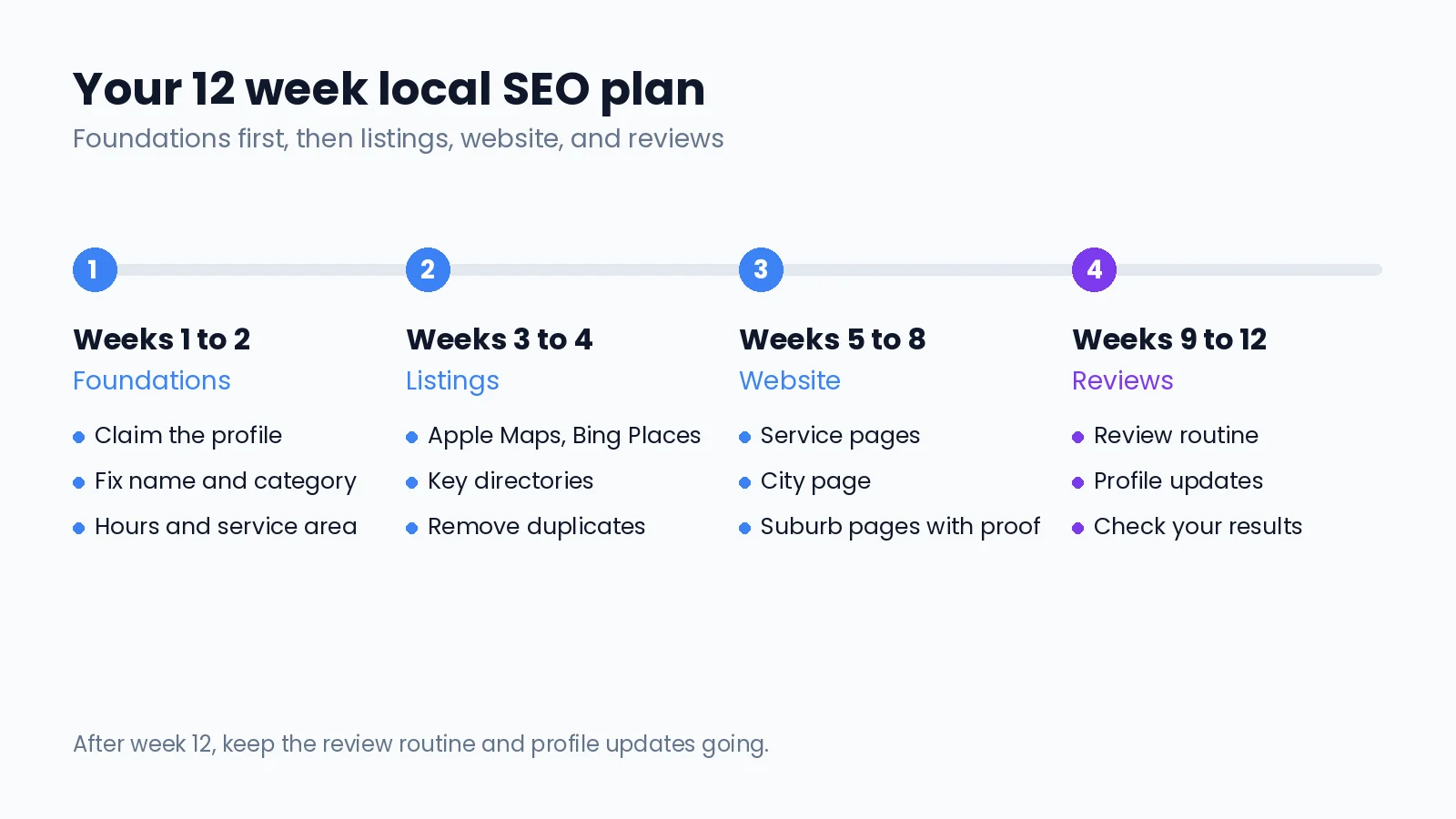
12 week local SEO plan
What to do and when
| Weeks | Focus | Tasks |
|---|---|---|
| 1 to 2 | Foundations | Claim and complete your Business Profile, fix your name, category, hours, and service area |
| 3 to 4 | Listings | Update Apple Maps, Bing Places, and key directories, remove duplicates |
| 5 to 8 | Website | Build or improve service pages, a city page, and suburb pages with real proof |
| 9 to 12 | Reviews and growth | Start a review routine, post updates, and review your results |
After 12 weeks, keep the review routine and profile updates going. Local SEO isn't a one-off job, but the ongoing work is small once the foundations are in place.
Should you do local SEO yourself or hire help?
You can do most of steps one to three yourself in a few evenings. The website work in steps four and five takes longer and benefits from experience.
If you'd rather hand it over, our guide to SEO cost in Australia explains what local SEO costs and what a monthly fee should include. For the bigger picture, see our SEO checklist for established businesses.
Frequently asked questions
How long does local SEO take to work?
Fixes to your Business Profile, like the category and hours, can show up within weeks. Building reviews and local pages usually takes three to six months to show steady results, and longer in competitive suburbs.
Do I need a page for every suburb?
No. Build one strong city or region page, then add suburb pages only where you can show real jobs, photos, and reviews from that area.
Can I rank in Google Maps without a shopfront?
Yes. Service area businesses, like most tradies, can set a service area and hide their address. You still need a genuine business address to verify the profile.
What matters more: reviews or listings?
Both matter, in different ways. Reviews win clicks and calls. Consistent listings help Google trust your details, which supports your rankings.
Is local SEO worth it for a tradie or clinic?
Usually, yes. Local searches come from people who need help now, close by. For most trades and health practices, the map results are where the best enquiries come from. Our guide to marketing for tradies shows how local SEO fits with reviews, your website, and Google Ads.
Your next step
The bottom line: local SEO rewards the businesses that get the basics right and keep at it. If you want to know where you stand, start with an honest look at your profile, reviews, and website.
Our free digital audit checks your Google Business Profile, your local rankings, and your website, then tells you what to fix first. Book your free digital audit, or see how our SEO services handle local SEO for you. You can also read about us and how we work.