Your website is five or six years old, and it still works, mostly. But it looks dated next to your competitors, it's slow on a phone, and the enquiries have dropped off. You know it needs a redesign, and you want to know what that should cost before you ask for quotes.
Here's the short answer: in Australia, the typical website redesign cost for an established business is $4,000 to $12,000 for a full redesign. A visual refresh that keeps your structure and content runs $1,500 to $5,000. A redesign that includes a platform move costs more. Large and ecommerce sites can reach $15,000 to $30,000 and beyond.
This guide breaks down where that money goes, what pushes the price up, and how long it takes. It also covers the expensive mistake most cheap redesigns make: losing the Google rankings you already have.
If you're building from scratch rather than redesigning, our guide to website design cost in Australia covers new build pricing in detail.
Refresh or full redesign: which one do you need?
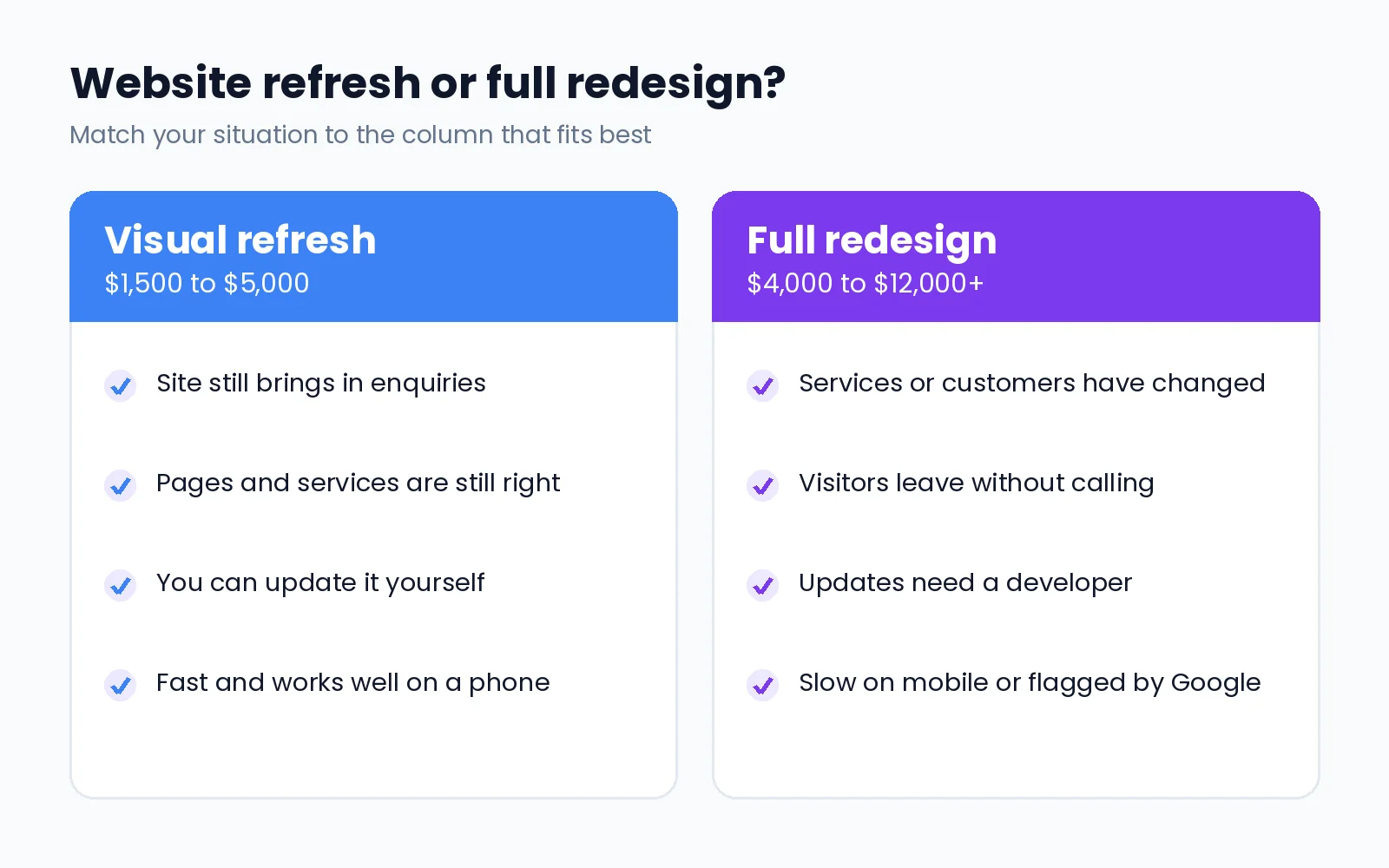
The biggest factor in your website redesign cost is the type of job.
- A visual refresh is a new look on your existing site. Same pages, same platform, mostly the same content.
- A full redesign is a rebuild of how the site works. New structure, new design, and rewritten key pages, often on a new platform.
A refresh changes how your site looks, while a full redesign changes how it works.
A refresh is usually enough when:
- Your site still brings in enquiries, but the design looks tired.
- Your pages, services, and structure are still right for the business.
- You can update content yourself without calling a developer.
- Your site loads quickly and works well on a phone.
You need a full redesign when:
- Your services, locations, or target customers have changed.
- Visitors land on the site and leave without calling or booking.
- Simple updates need a developer, or the site breaks when plugins update.
- It's slow on mobile, or Google flags problems in Search Console.
- Your brand has changed and the site no longer matches it.
For most established businesses we speak with, the honest answer is a full redesign. The site was built for the business as it was five years ago. A new coat of paint won't fix a structure that no longer matches what you sell.
Where the money goes in a website redesign
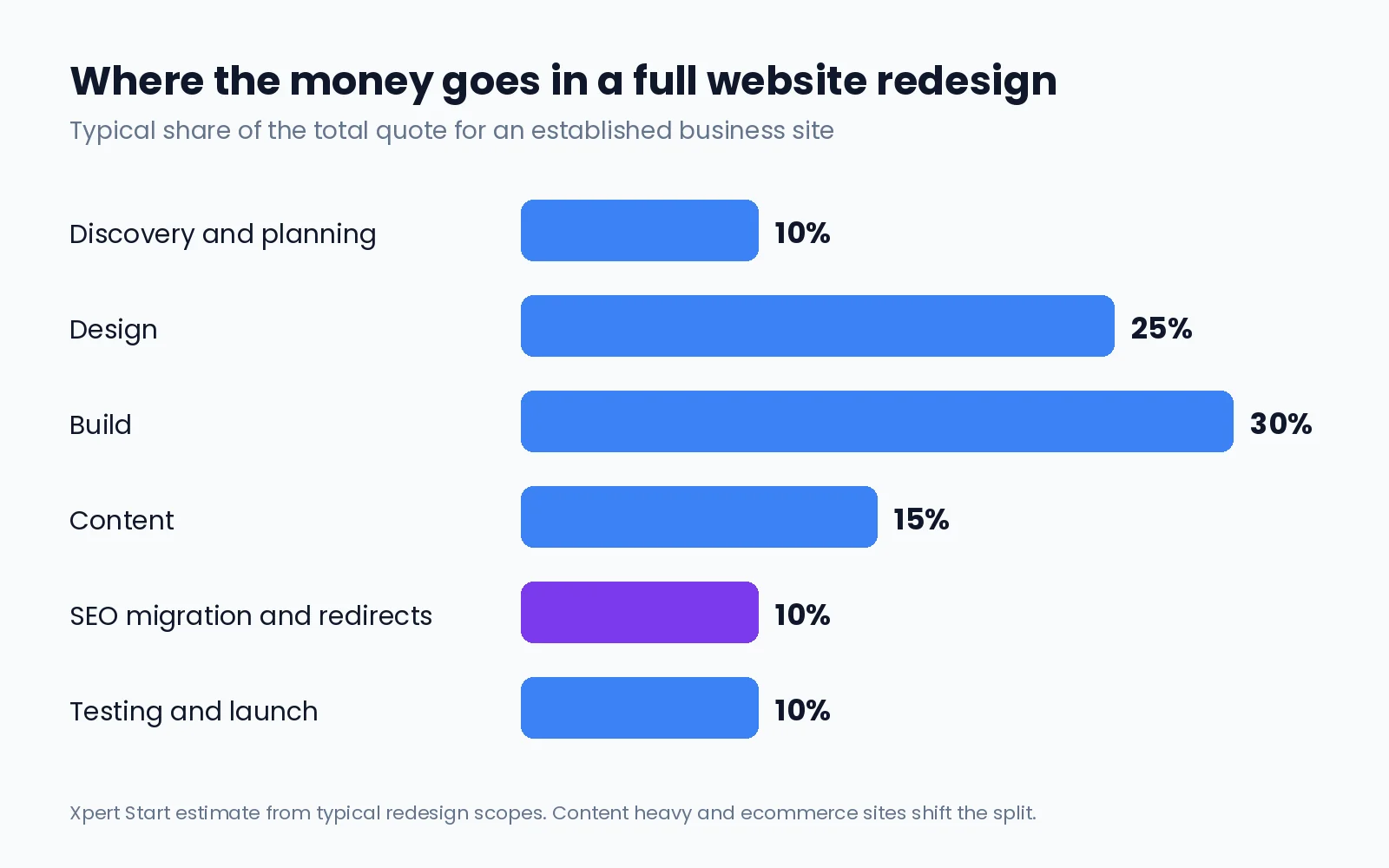
A redesign quote is a bundle of separate jobs. Here's how a typical full redesign splits up, and what each part pays for.
- Discovery and planning (about 10%). Reviewing your current site, your traffic, your competitors, and what your customers need to find. This is where the new page structure gets decided.
- Design (about 25%). Page layouts, mobile versions, and the visual style, signed off before anything gets built.
- Build (about 30%). Developing the pages, forms, and integrations on your chosen platform.
- Content (about 15%). Rewriting key pages, moving the rest across, and sourcing photos.
- SEO migration (about 10%). Mapping every old URL to a new one, setting up redirects, and carrying across titles and descriptions.
- Testing and launch (about 10%). Checking every page, form, and redirect on desktop and mobile, then watching Search Console after launch.
That split is a guide, not a rule. A content heavy site spends more on content, and a site with bookings or a store spends more on the build.
When two quotes differ by thousands of dollars, compare them line by line against this list. The cheaper quote usually skips discovery, content, or SEO migration. Those are the three parts that decide whether the new site brings in more work than the old one.
What pushes the price of a redesign up
These are the factors that move a quote from the bottom of the range to the top.
- Number of pages. A five page site and a 40 page site are different jobs. Service pages and location pages each need their own content and their own redirect.
- Content rewriting. Reusing your existing copy is cheaper. Rewriting it so it answers customer questions and targets the right searches costs more and earns more.
- Integrations. Booking systems, CRMs, quote forms, and payment gateways all add build and testing time.
- Ecommerce. Every product, category, and variant needs moving and checking. Stores are the most expensive sites to redesign.
- A platform move. Moving from WordPress, Wix, or Squarespace to Webflow means rebuilding rather than reskinning. It costs more upfront and usually less to run over the following years.
- Photography and video. Real photos of your team, your work, and your premises beat stock images every time, so budget for a professional shoot if you don't have them.
- Branding. If your logo and colours are changing too, the brand work comes first and is a separate cost.
On the other side, the ongoing costs often drop after a redesign. Moving off a plugin heavy WordPress site to Webflow removes most plugin updates and security patching. That's money you stop spending every month.
The real cost of a redesign done badly
The most expensive redesign is the one that loses your rankings.
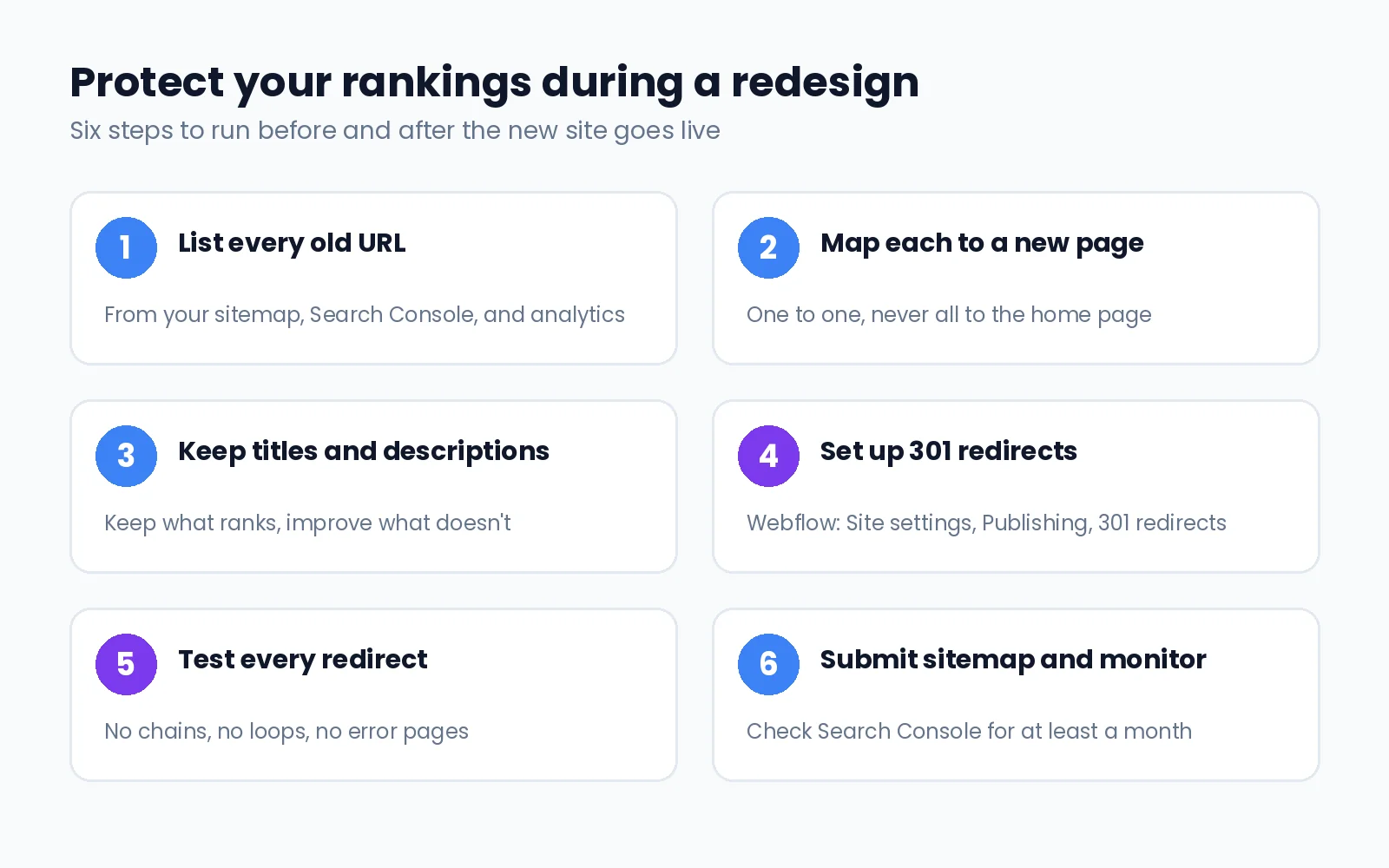
A 301 redirect is a permanent forwarding address for a web page. It sends visitors and Google from an old URL to its new one.
Your old site has pages that Google already ranks, that other websites link to, and that customers have bookmarked. If the new site changes those addresses and nobody sets up redirects, all of that points to an error page. Rankings drop, the phone goes quiet, and it can take months to recover the ground you lost.
Google's guidance on moving a site is clear on how to avoid it. Map every old URL to its new home and use permanent (301) redirects. Avoid redirect chains, and keep the redirects in place for at least a year. In Webflow, you set these up in Site settings under Publishing, as explained in Webflow's redirect guide.
This is the part a cheap quote leaves out, so ask every agency how they handle redirects and Search Console after launch. If they don't have a clear answer, keep looking. A technical SEO audit of the old site before work starts, and of the new one after launch, catches anything that slips through. Our SEO services include this migration work for every redesign we do.
The Bureau of Meteorology's redesign is the extreme example of a project where scope got away from everyone. AAP reported the total cost as $96.5 million. The bureau says the website was only about 10% of a much larger project replacing its back end systems. The lesson for an established business is simple: the visible design is rarely the expensive part, while unclear scope and hidden systems work are.
How long does a website redesign take?
Timelines follow the same pattern as cost. More pages, more content, and more integrations take longer.
The most common delay isn't the design or the build: it's the content. If your agency is writing the copy, the project moves faster. If you're writing it yourself, start before the design begins.
Is a website redesign tax deductible?
It can be, but often not all in one year. The ATO's ruling on commercial website expenditure (TR 2016/3) separates two kinds of spending.
- Routine changes such as small content updates, hosting, and licence fees are generally deductible in the year you pay them.
- A redesign that adds new functionality or materially improves the site is generally a capital cost. It's usually treated as in-house software and claimed over five years.
Most full redesigns fall into the second group. Talk to your accountant before you sign, so you know how the cost will land on your tax return.
How to get an accurate website redesign quote
Vague briefs get vague quotes, so send every agency the same information and you'll get quotes you can compare.
Your redesign brief checklist:
- Your current website address and the platform it runs on.
- The number of pages, and which ones bring in the most enquiries.
- What's wrong with the current site, in your own words.
- Your main services, locations, and ideal customers.
- Must have features: bookings, quote forms, a store, or integrations.
- Who will write the content and supply the photos.
- Your budget range and any hard deadline.
Then ask each agency these questions:
- What's included, and what costs extra?
- How do you handle redirects, Search Console, and SEO during the move?
- Who owns the site, domain, and content when it's finished?
- What happens after launch if something breaks?
- Can I update the content myself once it's live?
A good agency answers these questions clearly and without hesitation. If you want to see what a redesign covers with us, our Webflow web design page sets out the process from planning to handover.
Frequently asked questions
What is the average cost of a website redesign in Australia?
For an established business, a full website redesign usually costs $4,000 to $12,000. A visual refresh can cost $1,500 to $5,000. Large custom and ecommerce redesigns often run $15,000 to $30,000 or more.
Is it cheaper to redesign a website or build a new one?
A refresh is cheaper than a new build because it reuses your structure and content. A full redesign usually costs about the same as a new build of the same size. You're paying for new design, new pages, and the work of protecting what your old site already earns.
Will a website redesign affect my SEO?
It can, in either direction. A redesign with proper redirects, the same or better content, and a faster site often improves rankings. A redesign that changes URLs without redirects can lose rankings for months.
How often should a business redesign its website?
Most established businesses need a full redesign every four to six years, with smaller refreshes in between to keep it current. Redesign sooner if your services, brand, or customers have changed.
Can I redesign my website without changing platforms?
Yes, and many redesigns stay on the same platform. A platform move makes sense when the current one is slow, hard to update, or costly to maintain.
Your next step
A redesign is worth doing properly once, rather than cheaply twice. Before you collect quotes, it helps to know what your current site is doing well and what's holding it back.
Our free digital audit looks at your website, your Google rankings, and your enquiry path. It tells you whether you need a refresh or a full redesign. Book your free digital audit and you'll have a clear scope to take to any agency, including us. You can also read about us and how we work.