A customer with a burst pipe or a switchboard that keeps tripping doesn't browse. They search, open two or three sites on their phone, and call the one that looks local, trusted, and easy to contact. Your website has about a minute to win that call.
Here's the short answer on websites for tradies. A good tradie site has one job: turning a local search into a phone call or quote request. That means a call button on every screen, a page for each service and the areas you cover, real photos of your work, reviews, and your licence details. Most professional tradie websites cost $3,500 to $8,000.
This guide covers what your site needs, the pages to build, the licence rules for advertising, what it costs, and how to tell if it's bringing in work.
What a tradie website needs
The essentials, in the order customers look for them
| Must have | Why it matters |
|---|---|
| Call button on every screen | Most customers are on a phone and want to talk now |
| Services and service areas | Shows you do the job, in their suburb |
| Real job photos | Proves the quality of your work |
| Reviews | Lets customers trust you before they call |
| Licence and insurance details | Required in ads in some states, and builds trust |
| Short quote form | Catches customers who can't call straight away |
| Fast loading on phones | Slow sites lose the call to the next result |
Do tradies still need a website?
Many tradies get by on referrals and a Google Business Profile. So why pay for a website?
Because referred customers check you out too. They search your business name, read your reviews, and look for your website before they call. If there's nothing there, or an old site that doesn't work on a phone, some will call someone else.
A website also does things a profile can't. It explains each service in detail, shows every suburb you cover, and ranks in the normal search results as well as the map. Google's own guidance on how local results are ranked names relevance, distance, and prominence, and says information from across the web, including your website, counts toward prominence.
There's a cost question too. A lead portal is a website that sells the same job enquiry to several tradies at once. You pay for each lead and compete on price for it. Your own website sends the enquiry to you alone, and every page you add keeps working for years.
For the bigger picture of where a website fits alongside reviews, Google Ads, and SEO, see our guide to marketing for tradies.
What a tradie website needs

Customers decide fast, so put the important things where they'll see them first. Here's what every tradie site should have.
1. A call button on every screen
Click to call is a button that dials your number when a customer taps it on their phone. Put it in the header, repeat it after each section, and add a call bar that stays at the bottom of the screen on phones. Show the number as text too, for people on a desktop.
2. A clear headline that says what you do and where
Visitors should know in three seconds that you're the right tradie. For example, "Licensed electricians in the Hills District. Same day callouts." beats "Welcome to our website" every time. Add your main service area and one reason to choose you.
3. A page for each service
One page per service you want more of: hot water, blocked drains, leak detection, switchboard upgrades, and so on. Each page explains what the job involves, common problems, rough timeframes, and photos of that job. This is how you show up when someone searches for that exact service.
4. Service area pages
A service area page is a page about the work you do in one suburb or region. It tells customers and Google that you work there. Write real content for each one: the jobs you do there, the local conditions, and photos from nearby jobs. Copying the same page and swapping the suburb name doesn't help anyone. Our local SEO guide covers how to plan them.
5. Real photos of your work
Stock photos of smiling models in clean overalls don't convince anyone. Use photos from your own jobs: before and after shots, your vans, your team in uniform. A phone photo of a tidy finished job is worth more than any stock image.
6. Reviews and proof
97% of consumers read reviews for local businesses, according to BrightLocal's local consumer review survey. Show your Google rating and a few recent reviews on the home page and each service page. Add any accreditations and association memberships you hold.
7. Licence and insurance details
Show your licence number, the licence holder's name, and your insurance cover. In some states it's a legal requirement for advertising (see the next section). It also separates you from unlicensed operators.
8. A short quote form
Some customers can't call from a job site or an office. Give them a form with four or five fields: name, phone, suburb, the job, and an option to upload a photo. Every field you add means fewer people finish the form.
9. Speed on phones
Most tradie customers are on a phone, often on mobile data. Compress your photos, keep the design simple, and test the site on your own phone away from Wi-Fi. If it's slow for you, it's slow for them.
Licence details on your website: what the rules say
Advertising rules for tradies are set by each state, and your website counts as advertising.
- New South Wales. The NSW Government's guide to building trade advertisements says the licensee's name and licence number must be shown in all advertising, including on the internet. Fair Trading also requires the category of work and a business phone number.
- Queensland. The QBCC's advertising rules say ads must show the name you're licensed under, state that you're licensed under the QBCC Act, and include your licence number. The details must be easy to read and reasonably prominent. A trading name on its own will most likely not comply.
Other states and some trades, like electrical and gas, have their own rules. Check with your licensing body before your site goes live. The simplest fix is to put your licence details in the footer, so they appear on every page.
The pages to build
Pages for a tradie website
What goes on each one
| Page | What goes on it |
|---|---|
| Home | Headline, service area, call button, reviews, job photos, main services |
| One page per service | What the job involves, common problems, photos, a call button |
| Service areas | Real content for each main suburb or region |
| About | Your story, team, licences, insurance, and years in business |
| Gallery or recent jobs | Before and after photos with a short note on each job |
| Reviews | Your Google rating and recent reviews |
| Contact | Phone, quote form, hours, and the areas you cover |
A five page site covers the home, services, about, gallery, and contact pages. As you grow, add a page for each main service and suburb. Those extra pages are what bring in searches for specific jobs.
What a tradie website costs
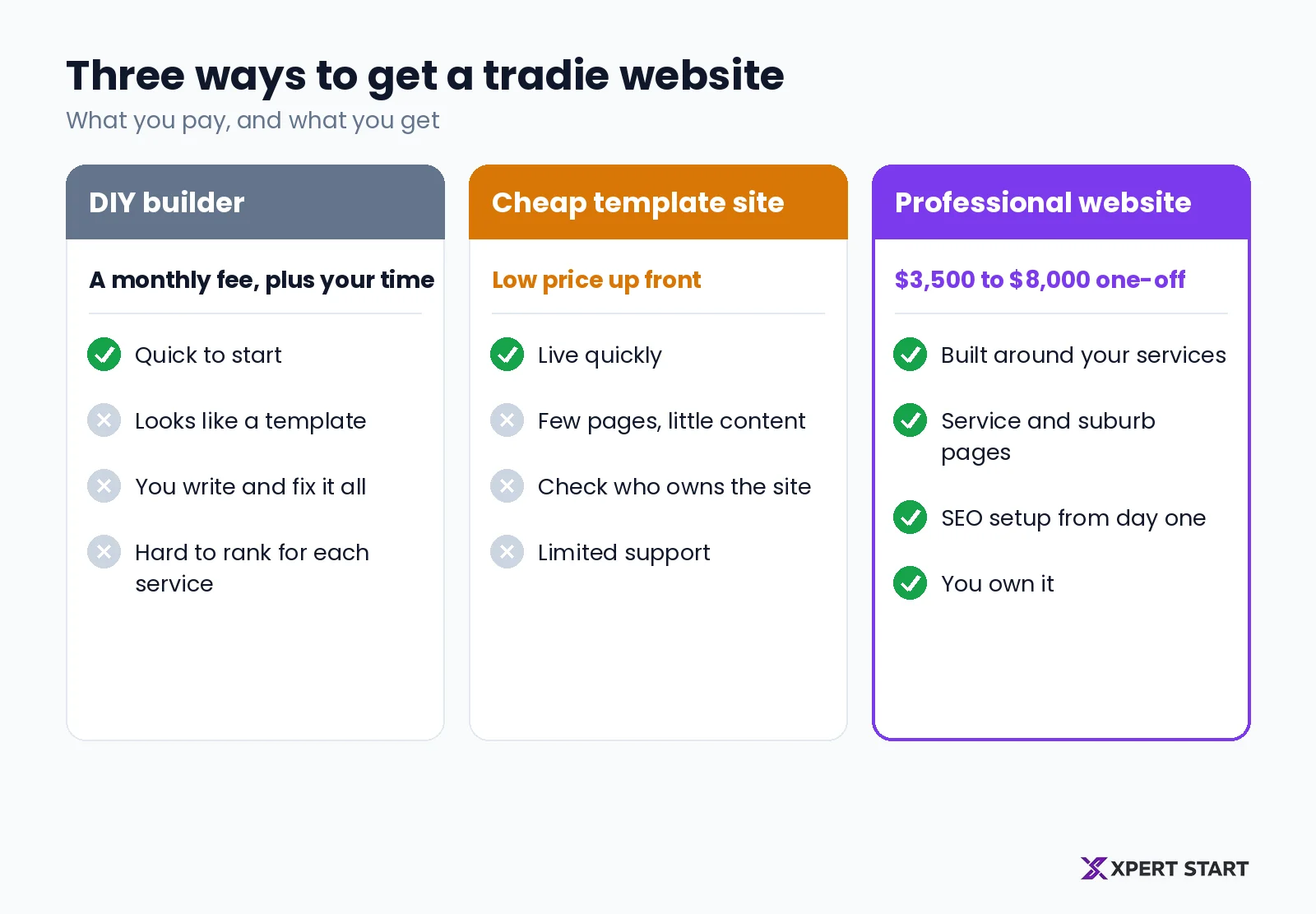
Most professional tradie websites cost $3,500 to $8,000. A five page site with services, service areas, a gallery, and click to call usually sits around $5,000 to $6,000. Online booking, quoting tools, or a large number of suburb pages add to the cost.
Then there are running costs: hosting, your domain name, and any updates you pay for. Our guide to website cost in Australia breaks down every line, including the costs people forget.
DIY, builder, or professional?
There are three common ways to get a tradie website. Each has a place.
- A DIY website builder. Low monthly fee, but it costs your time, and the result often looks like a template. It's fine for a brand new business. It rarely holds up against established competitors.
- A cheap template site. A low price up front, usually with few pages, little help with content, and sometimes a contract that means you don't own the site. Check who owns the domain and the site before you sign.
- A professional website. Built around your services, areas, and customers, with the pages above and proper SEO setup. It costs more up front, and it's yours.
The platform matters too. We build on Webflow because it's fast, secure, and easy to edit without breaking the design. Our comparison of Webflow vs WordPress explains the trade offs, including who does the maintenance.
How to tell if your website is working
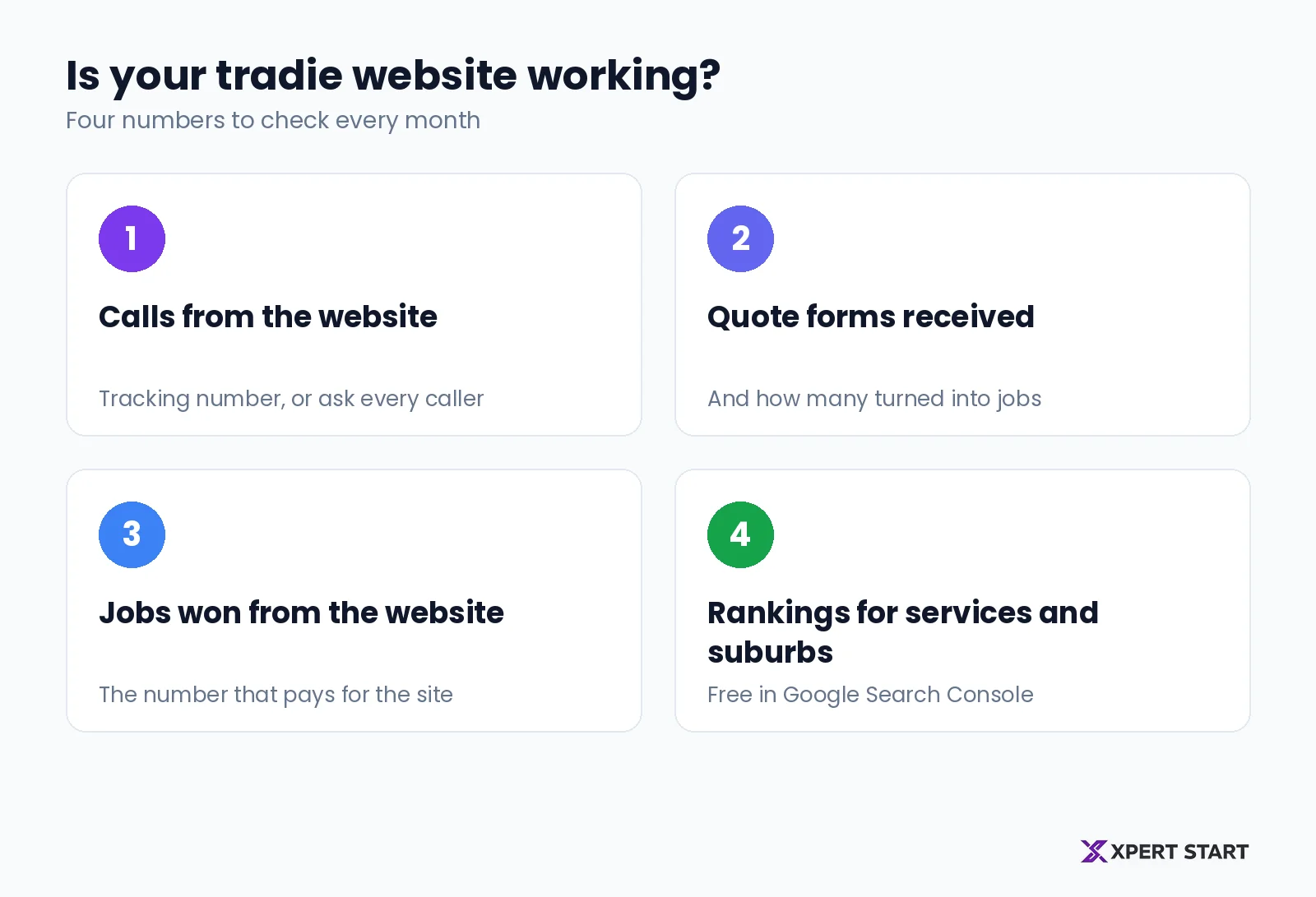
Traffic numbers on their own don't pay the bills. Track the things that do:
- Calls from the website. Use a tracking number on the site, or ask every caller how they found you.
- Quote forms received. Count them each month, and how many turned into jobs.
- Jobs won from website enquiries. This is the number that tells you whether the site pays for itself.
- Rankings for your main services and suburbs. Google Search Console is free and shows the searches your site appears for.
For example, if a $6,000 website brings in two extra jobs a month at $1,500 each, it pays for itself within a few months. If calls don't come, look at the pages first: is the call button easy to find, and does the page answer what the customer searched for? If the site isn't showing up at all, that's an SEO problem, and our SEO services can help with it.
Common tradie website mistakes
- No phone number at the top. If customers have to scroll to find it, many won't.
- One page for everything. A single services list can't rank for every job you do.
- Stock photos. Customers can tell, and they trust real job photos more.
- Missing licence details. It can breach advertising rules and costs you trust.
- A long quote form. Ten fields means most people give up.
- Not owning your site. If your builder owns the domain or the site, leaving gets expensive.
- Never updating it. Old photos, old services, and a copyright year from five years ago all signal a business that's slowed down.
Frequently asked questions
How much does a tradie website cost?
Most professional tradie websites cost $3,500 to $8,000. A five page site with services, service areas, a gallery, and click to call usually sits around $5,000 to $6,000. Booking tools and extra suburb pages add to the cost.
Do tradies need a website if they have a Google Business Profile?
Yes. Your profile helps you show up in the map, but your website explains each service, covers every suburb you work in, and ranks in the normal search results. Customers who find your profile often check your website before they call.
What should a tradie website include?
A call button on every screen, a page for each main service, service area pages, real job photos, reviews, your licence and insurance details, and a short quote form. It should also load fast on a phone.
Should my licence number be on my website?
In New South Wales and Queensland, the advertising rules require your licence details in ads, and that includes your website. Other states and trades have their own rules. Putting the details in the footer covers every page.
What's the best website builder for tradies?
A DIY builder can work for a brand new business on a tight budget. For an established tradie competing for local jobs, a professionally built site on a platform like Webflow usually brings in more calls, because it's built around your services and areas.
The bottom line
A tradie website has one job: turning local searches into calls and quotes. Put the call button everywhere, build a page for each service and area, show real work and real reviews, display your licence details, and keep it fast on a phone. Then track the calls, forms, and jobs it brings in.
If your current site isn't bringing in work, our free digital audit shows what's holding it back and what to fix first. Book your free digital audit, see how our Webflow web design works, or read about us.