Most clinics grow on GP referrals and word of mouth. That works until a new practitioner joins with an empty diary, a nearby clinic opens, or referrals slow down over the holidays. Then the question becomes what to do first, and what you're allowed to say when you advertise.
Here's the short answer on clinic marketing. Get found locally first: a complete Google Business Profile, a steady flow of reviews, and an up to date Healthdirect listing. Then make booking easy on your website, keep existing patients coming back with rebooking and recalls, and add Google Ads and SEO to bring in new patients. Throughout, stay inside the Ahpra advertising rules, which ban clinical testimonials in your own advertising.
This guide covers the rules, the order to do things in, what each channel costs, and how to measure what's working. It applies to physio, chiro, podiatry, psychology, dental, and other allied health clinics.
Clinic marketing channels at a glance
What each one costs and how fast it works
| Channel | Typical cost | Time to results | Best for |
|---|---|---|---|
| Google Business Profile | Free, plus your time | Weeks | Showing up in the map results |
| Reviews | Free, plus a simple process | Ongoing | Winning the booking over nearby clinics |
| Website with online booking | $4,000 to $8,000 one-off | Live in three to five weeks | Turning searches into bookings |
| Rebooking and recalls | Your practice software | Straight away | Keeping your books full |
| Google Ads | Ad spend plus management | Days | New patients quickly |
| SEO | Monthly, from $1,000 | Three to six months and beyond | Steady new patients without paying per click |
The advertising rules come first
Health clinics can't market the way a café or a builder does. Ahpra's guidelines for advertising a regulated health service apply to every registered health practitioner, and to anyone advertising their services. The main points for marketing:
- No testimonials in your advertising. The National Law prohibits using testimonials to advertise a regulated health service. A testimonial is a recommendation or positive statement about the clinical side of your care, like "my back pain was gone after two sessions".
- Service comments are fine. Comments about customer service, like friendly staff or easy parking, aren't treated as testimonials.
- Patients can still review you. Patients posting reviews on review platforms isn't restricted. That said, you're responsible for advertising you control, so don't copy clinical reviews onto your website, ads, or social posts.
- No misleading claims. That includes leaving out important details, or using "specialist" when a practitioner doesn't hold specialist registration.
- Offers need terms. If you advertise a discount or a free assessment, state the terms clearly, and make sure "free" really means free.
This isn't legal advice. Check Ahpra's guidance and your board's codes before you run ads, and when in doubt, leave it out.
The order to do it in

Each step makes the next one more profitable. Paid ads that send people to a website with no online booking waste money. A full diary of new patients who never rebook is a leaky bucket.
- Google Business Profile and directories. Free, and it's where local patients look first.
- Reviews. They decide which clinic gets the booking.
- A website that's easy to book from. Every other channel sends people there.
- Rebooking and recalls. The cheapest appointments you'll ever fill.
- Google Ads. The fastest way to bring in new patients.
- SEO. Slower, but it builds bookings you don't pay for per click.
Step 1: Get found on Google Maps and Healthdirect
A Google Business Profile is your free listing on Google Search and Maps. When someone searches "physio near me" or "podiatrist Castle Hill", the map results usually appear first. Google's guide to how local results are ranked names relevance, distance, and prominence, and says more reviews and positive ratings can help your local ranking.
- Choose the most accurate primary category, like "Physiotherapist" or "Chiropractor", and add the others that apply.
- List every service, your practitioners, opening hours, and whether you have parking or wheelchair access.
- Add a booking link that goes straight to your online booking page.
- Add real photos of your rooms, reception, and team. Update them a few times a year.
Then check your directory listings. Healthdirect runs the national directory behind its service finder, and you can register your practice with the NHSD or update the details if you're already listed. Keep your name, address, and phone number identical everywhere.
Step 2: Build a steady flow of reviews
Reviews matter as much for clinics as any local business. 97% of consumers read reviews for local businesses, according to BrightLocal's local consumer review survey.
A simple process that stays inside the rules:
- Ask at the right moment, like when a patient finishes a course of treatment and is happy with the result.
- Send a direct link to your Google review page by SMS or email.
- Reply to every review politely and briefly, without confirming that the person is a patient or discussing their care.
- Don't reuse clinical reviews in your ads, website, or social posts.
Step 3: Make your website easy to book from
Your website has one main job: turning people who found you into bookings. For a clinic, that means:
- Online booking on every page, linked to your practice software.
- A page for each service and condition you treat, in plain words patients use: "back pain", "sports injuries", "headaches".
- Practitioner profiles with qualifications, interests, and the days they work.
- Fees, health fund rebates, and what to expect at the first appointment.
- Location details: parking, public transport, and accessibility.
For example, a physio clinic that shows its first appointment fee and has a "Book online" button in the header makes the decision easier than one that only lists a phone number. Most clinic websites cost $4,000 to $8,000 to build properly. Our guide to website cost in Australia breaks down what's included at each price.
Step 4: Keep patients with rebooking and recalls
The APA describes this as the leaky bucket: patients leave because they get better, move, or simply forget to rebook. Filling your diary with people who already know you is cheaper than finding new ones.
- Rebook at the front desk before the patient leaves, following the practitioner's treatment plan.
- Set up recall reminders in your practice software for check ups, reviews, and seasonal classes.
- Follow up missed appointments the same day with a friendly SMS.
- Send a short email every month or two with useful tips, practice news, and new services, to patients who've agreed to receive it.
These steps don't involve advertising your clinical results, so they sit comfortably inside the rules.
Step 5: Add Google Ads for new patients now
Google Ads is Google's advertising platform. It puts your clinic at the top of the search results within days, and you pay when someone clicks. It suits new practitioners with empty diaries, a new service, or a new location.
- Target searches with booking intent, like "physio Parramatta" or "sports physio near me".
- Send each ad to the page about that service, with online booking on the page.
- Keep ad wording factual: no clinical claims, no testimonials, and clear terms on any offer.
Ad spend is paid to Google. Our Google Ads management starts at $750 setup plus $1,000 a month, including GST. Our Google Ads guide covers how to set a budget and what to expect.
Step 6: Invest in SEO for patients that keep coming
SEO is search engine optimisation: the work that helps your website rank in Google's normal results and map results. It usually takes three to six months to build, then brings bookings without paying for each click.
For clinics, SEO means a strong Google Business Profile, a page for each service and condition, suburb pages for the areas you serve, and helpful articles that answer patients' questions before they book. Our local SEO guide covers the steps. Our SEO plans start at $500 setup plus $1,000 a month.
Most established clinics do best running both. Our comparison of Google Ads vs SEO explains how to split a budget between them.
What clinic marketing costs
The useful question isn't what other clinics spend. It's what a new patient is worth to you over their whole course of care, and how much you can afford to pay to win one.
Cost per new patient is what you spend on marketing divided by the new patients it brings in. For example, if you spend $2,000 in a month and book 20 new patients, each new patient cost $100. If the average new patient attends five appointments, that's a good trade.
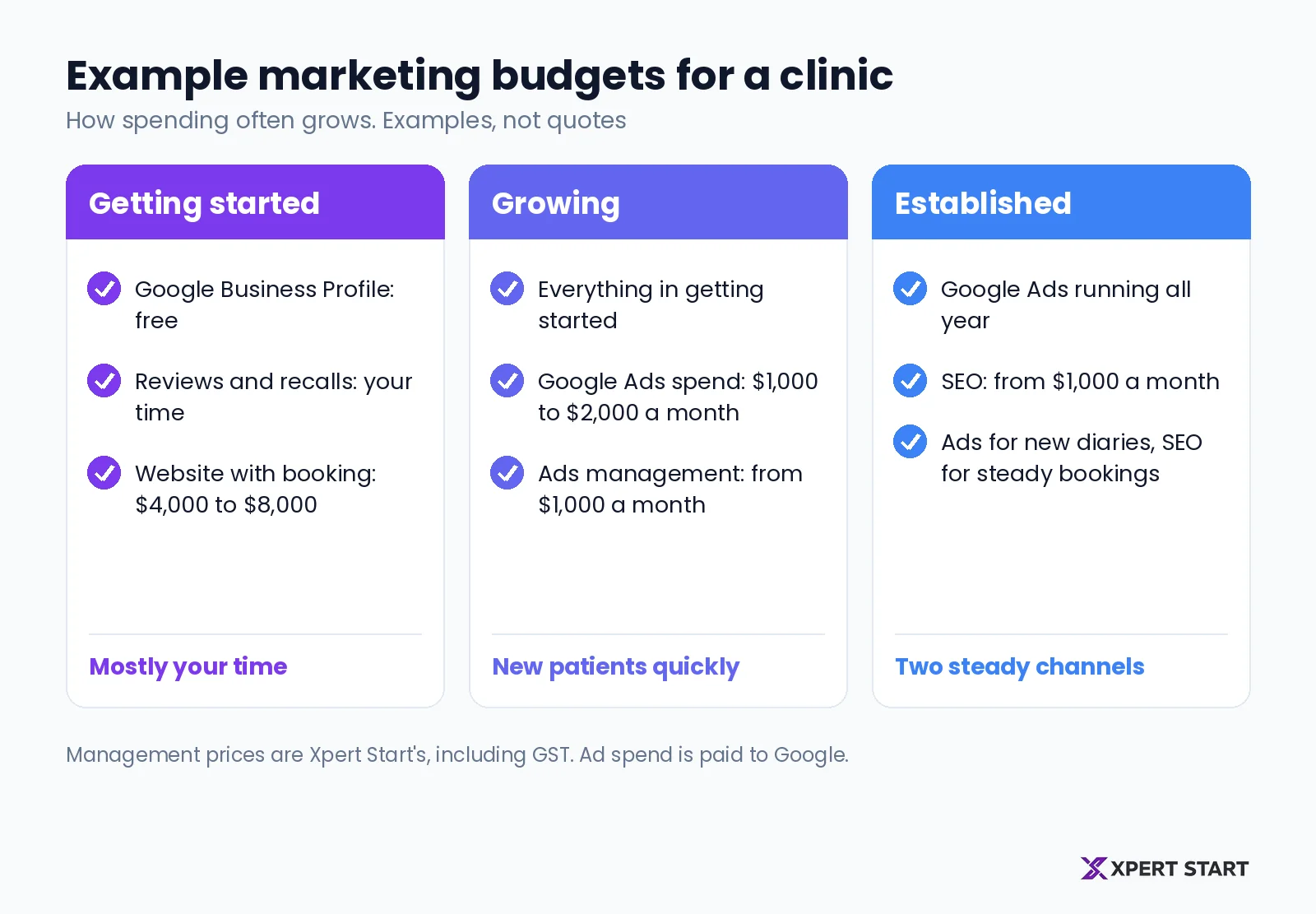
As a guide, here's how spending often grows:
- Getting started: a complete Google Business Profile, a review process, recalls, and a website with online booking. Mostly time, plus the one-off website cost.
- Growing: add Google Ads. For example, $1,000 to $2,000 a month in ad spend plus management.
- Established: run Google Ads and SEO together, with ads filling new practitioners' diaries and SEO building steady bookings.
These are examples, not quotes. Your profession, location, and competition all change the numbers.
How to tell if your marketing is working
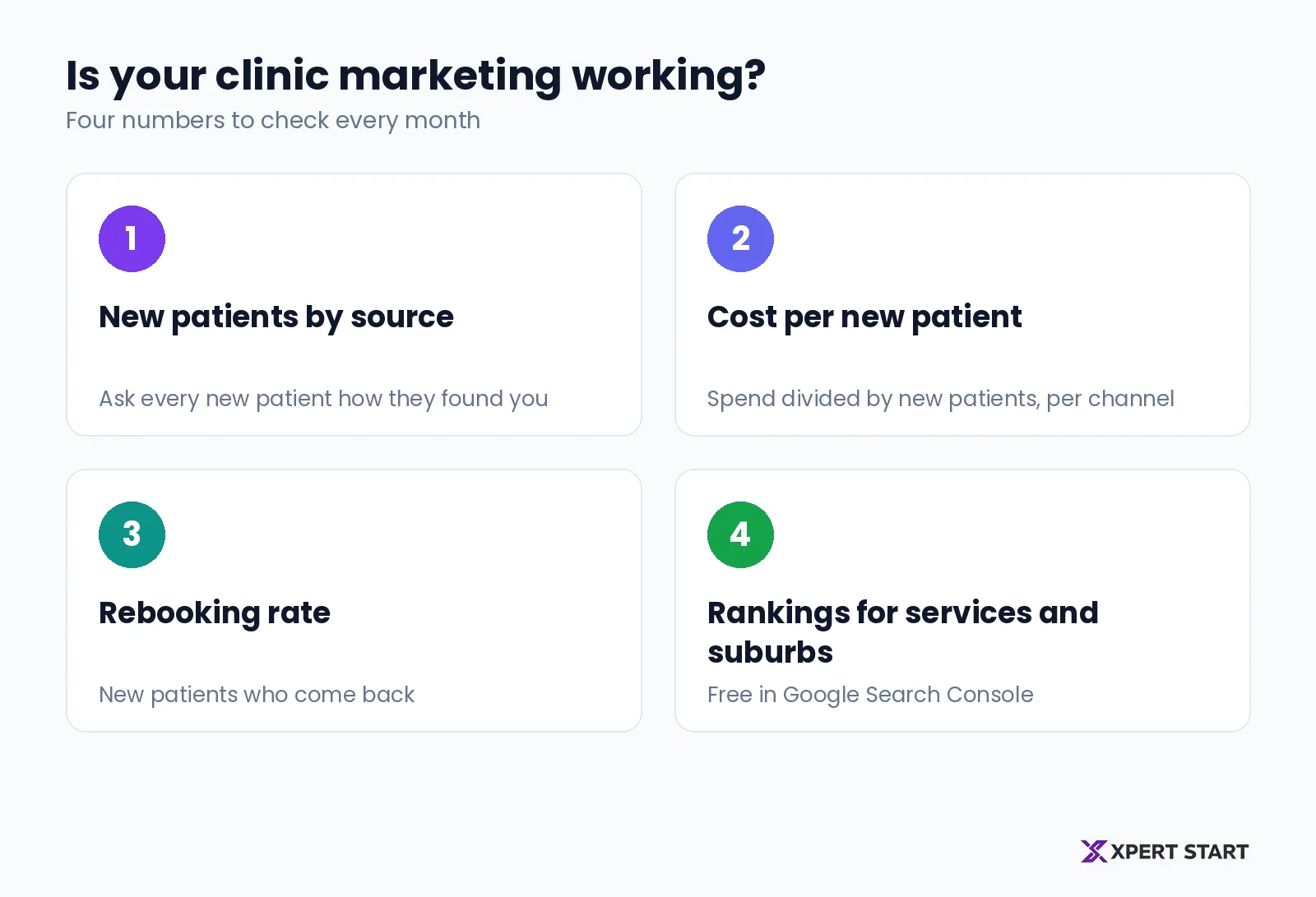
Your practice software already holds most of what you need.
- Ask every new patient how they found you, and record it in their file.
- Count new patient bookings by source each month: Google Maps, your website, ads, GP referrals, and word of mouth.
- Work out the cost per new patient for each paid channel.
- Track your rebooking rate, because a new patient who doesn't return is expensive.
For more ways to stop losing enquiries before they book, our guide on how to get more leads covers missed calls, slow replies, and follow ups.
Common clinic marketing mistakes
- Using testimonials in ads or on the website. It breaches the advertising rules, even if the patient offered it.
- Calling someone a specialist when they don't hold specialist registration.
- No online booking. Many patients search and book outside business hours.
- Running ads to the home page. Send them to the page for that service.
- Ignoring recalls. Existing patients are the cheapest bookings you'll get.
- Not tracking where new patients come from. Without it, you can't tell what's worth paying for.
Frequently asked questions
What is the best marketing for a health clinic?
For most clinics, a complete Google Business Profile, a steady flow of reviews, and a website with online booking bring the best return. After that, rebooking and recalls keep your diary full, and Google Ads and SEO bring in new patients.
Can clinics use testimonials in their marketing?
Not in their own advertising. The National Law prohibits using testimonials about clinical care to advertise a regulated health service. Patients can still post reviews on platforms like Google, and comments about customer service aren't treated as testimonials.
How do physios get more patients?
Start with your Google Business Profile and reviews, then make online booking easy and rebook patients before they leave. For new patients quickly, Google Ads works within days. SEO builds steady bookings over three to six months.
How much should a clinic spend on marketing?
Work it out from what a new patient is worth over their course of care. Decide what you can afford to pay for one new patient, then track the cost per new patient for each channel and move money toward what works.
Is Google Ads worth it for clinics?
It can be, especially for new practitioners, new services, or a new location. It works best with factual ads, a page for each service, and online booking on the page the ad sends people to.
The bottom line
Clinic marketing works best in order. Get found with a complete Google Business Profile and directory listings, win the booking with reviews, make your website easy to book from, keep patients with rebooking and recalls, then grow with Google Ads and SEO. Stay inside the Ahpra rules, and track the cost of every new patient.
Want to know where your clinic stands? Our free digital audit checks your Google Business Profile, reviews, website, and local competition, and shows what to fix first. Book your free digital audit, see our Webflow web design and Google Ads management, or read about us.