You've got a marketing budget and two agencies telling you different things. One says Google Ads will have the phone ringing next week, while the other insists SEO is the only investment that lasts. Both are partly right, and the choice comes down to how quickly you need work and how long you can wait for a return.
Here's the short answer to Google Ads vs SEO. Google Ads puts you at the top of Google straight away, but the traffic stops the day you stop paying. SEO takes months to build, but it keeps bringing in enquiries without paying for every click. Most established businesses do best with both, starting with the one that matches their urgency and budget.
This guide compares how each channel works, what each one costs, and how long each takes to deliver. It finishes with a practical decision guide and a 12 month plan for running both.
Google Ads vs SEO at a glance
How the two compare for an established business
| Google Ads | SEO | |
|---|---|---|
| How you pay | Per click, plus a management fee if you hire help | A monthly fee for the work, no cost per click |
| Speed | Ads can show within a day of going live | Usually three to six months for steady results |
| When you stop paying | Traffic stops the same day | Rankings fade slowly over months |
| Typical monthly cost | $1,000 to $5,000 ad spend, plus management | $1,000 to $3,000 with an Australian agency |
| Best for | Urgent work, new services, seasonal demand | Long-term enquiries and lower cost per lead over time |
Where each one shows up on Google
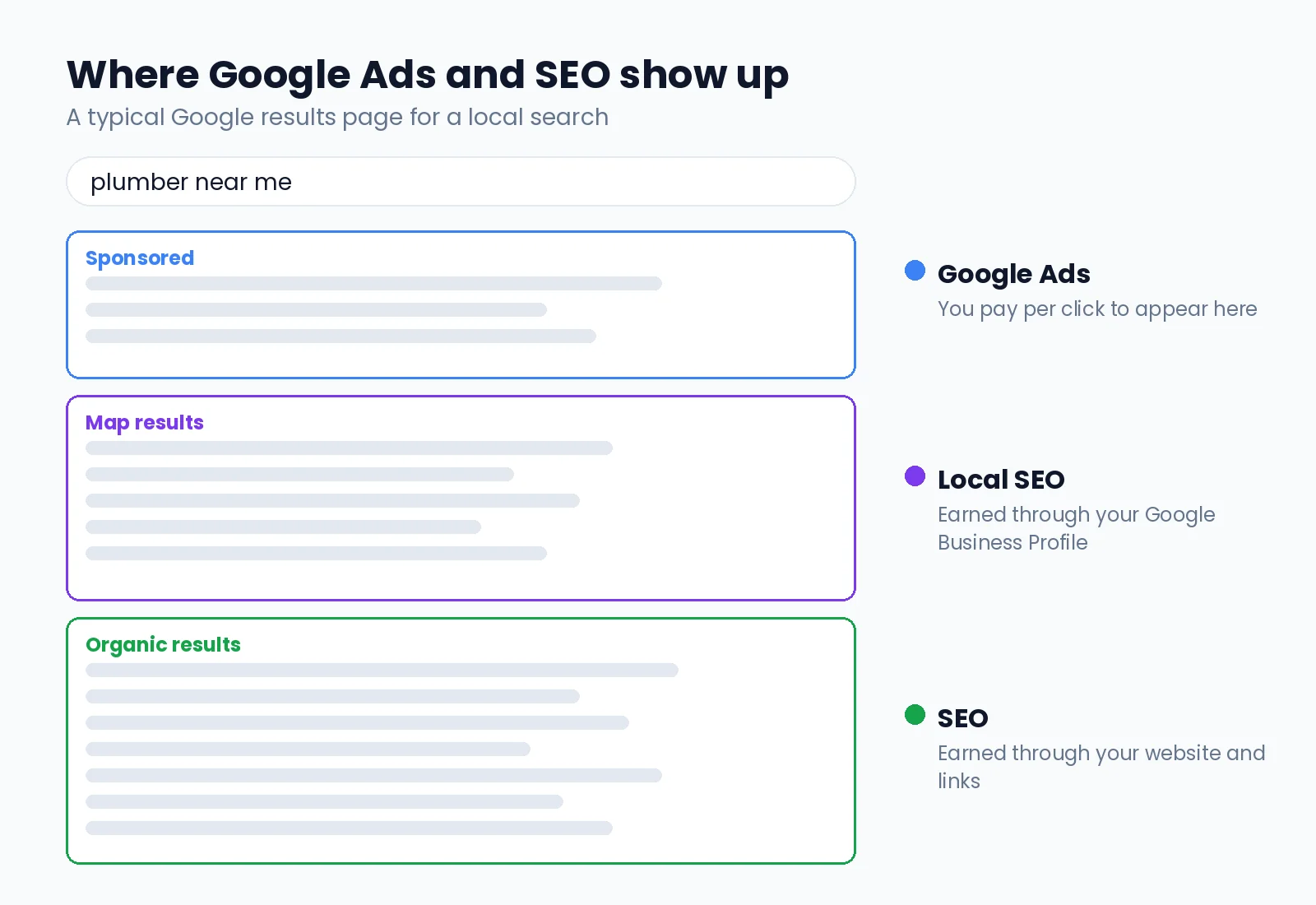
When someone searches "plumber near me", Google shows three kinds of results. Sponsored ads usually sit at the top, the map results come next for local searches, and the organic results sit underneath.
- Google Ads controls the sponsored listings. You pay to appear there.
- SEO covers the organic results and, through local SEO, the map results. You can't pay to appear there, only earn it.
That's why the two aren't really competitors: they occupy different positions on the same results page.
How Google Ads works
Google Ads is Google's advertising platform. You choose the searches you want to appear for, set a budget, and pay each time someone clicks your ad.
Cost per click is the amount you pay Google each time someone clicks your ad. The price of each click depends on how many competitors are bidding for the same search. It also depends on how relevant Google considers your ad and landing page. Busy, high-value searches like "emergency electrician Sydney" cost more per click than quieter ones.
The big advantage is control. You can promote a new service this week, target a single suburb, or pause advertising during quieter months.
How SEO works
SEO is the work of making your website the best answer to the searches your customers make, so Google ranks it in the organic results. The letters stand for search engine optimisation. It covers your website's content, its technical health, your Google Business Profile, reviews, and links from other sites. The Australian Government's guide to improving your search engine rankings describes it similarly. SEO helps search engines find your content and rank your website against similar websites.
There's no cost per click, so once a page ranks, every additional visitor from it is effectively free. The catch is time: Google's SEO starter guide says some changes take effect within hours, while others can take several months.
Does Google Ads help SEO?
Not directly. Google's official help page on online marketing states that running online ads has no impact on where your website appears in organic search results. Increasing your advertising budget won't improve your organic rankings.
But ads do help SEO in one practical way: data. Your Google Ads account shows exactly which searches lead to calls and bookings. That information tells you which pages to build and which keywords to prioritise with SEO.
For example, a physio clinic might find through its ads that "sports physio" searches convert far better than "back pain" searches. That's where its SEO effort should go first.
What each one costs
The two channels are priced differently, so compare them over a full year rather than a single month.
Google Ads has two costs:
- Ad spend, paid to Google. Many established local businesses spend $1,000 to $5,000 a month, and more in competitive industries.
- Management, if you hire someone to run the account. This is usually a flat monthly fee or a percentage of ad spend, often 10 to 20%.
We publish our own Google Ads management prices, so you can see what the management side costs. Ad spend is separate and is set with you during onboarding.
Xpert Start Google Ads management plans
Prices include GST, ad spend is separate
| Plan | Setup fee | Management fee | Platforms | Suits |
|---|---|---|---|---|
| Basic | $750 | $1,000 a month | Google or Meta | Your first paid campaign |
| Advanced | $1,000 | $2,000 a month | Google and Meta | Scaling across two platforms |
| Premium | $1,500 | 10 to 15% of ad spend | Google, Meta, and LinkedIn | Ad budgets of $10,000+ a month |
Every plan includes campaign setup, keyword research, ad copy, conversion tracking, ongoing negative keyword management, and a monthly report. Advanced adds A/B testing, competitor analysis, and remarketing. Premium adds a dedicated account manager and weekly reporting.
SEO is usually a single monthly fee to an agency, typically $1,000 to $3,000 for an established business. Our guide to SEO cost in Australia breaks that down, including our own prices.
Here's how that comparison plays out for a typical plumbing business:
- With Google Ads, they spend $2,000 a month on ads and pay a management fee. If clicks cost $8 and one in 10 clicks becomes an enquiry, each enquiry costs about $80 in ad spend. That cost is predictable from the first month.
- With SEO, they pay $1,500 a month. For the first few months, there may be very few additional enquiries. Once their service pages rank, enquiries arrive without a cost per click, and the cost per lead keeps falling the longer it runs.
Those figures are an illustration, not a quotation. The important difference is the pattern. Google Ads costs roughly the same per lead indefinitely, while SEO costs most per lead initially and least eventually.
Which should you choose?
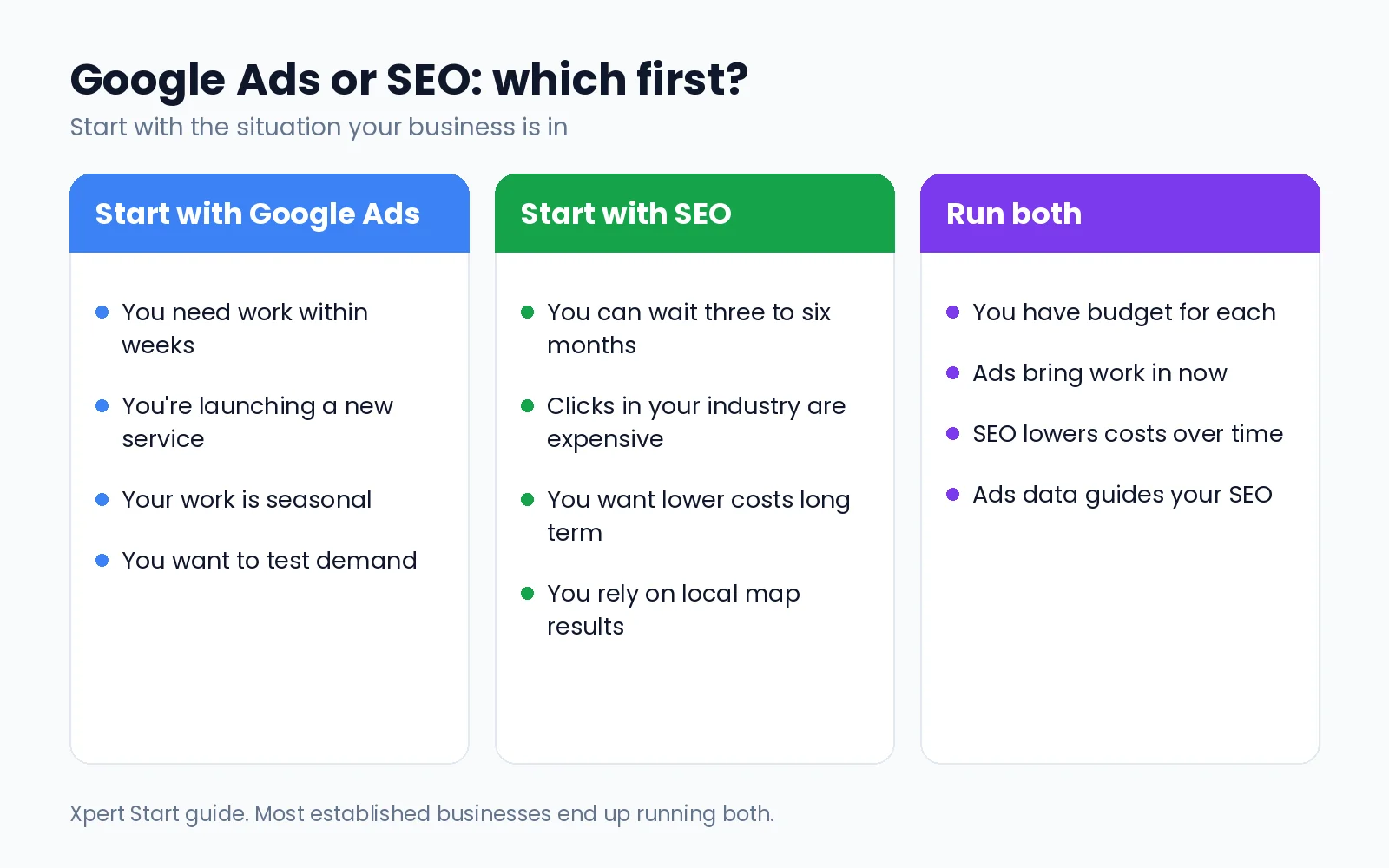
Use these five common situations as a guide.
- You need work within weeks. Choose Google Ads, because SEO won't deliver results quickly enough.
- You're launching a new service or a new area. Start with Google Ads to test demand, then build SEO pages for the searches that convert.
- Your work is seasonal. Use Google Ads to turn visibility up in busy months, and SEO to keep a steady base all year.
- Clicks in your industry are very expensive. Lean on SEO, because every organic visitor is one you didn't pay $15 or $20 for.
- You want lower marketing costs in two years' time. Invest in SEO now, even if you also run ads.
If you can only afford one, ask yourself one question: can the business survive three to six months without new enquiries from Google? If not, start with advertising. If it can, SEO is usually the better long-term investment.
For tradies and clinics, consider local SEO first, because the map results often generate the most phone calls. Our local SEO guide shows how to get there.
How to run Google Ads and SEO together
The strongest strategy for most established businesses is combining both, in a deliberate order.
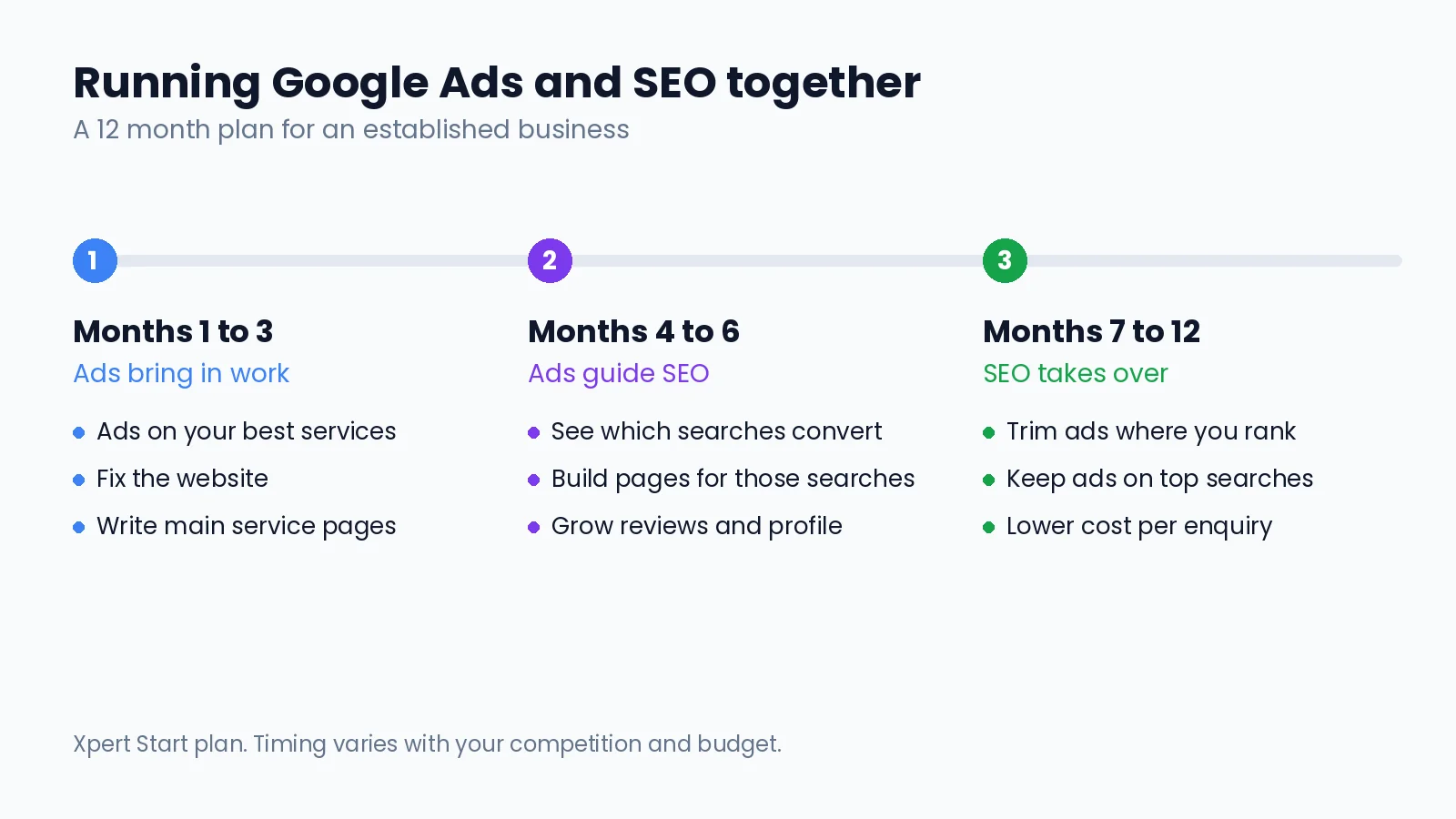
- Months one to three. Run Google Ads on your most valuable services to bring in enquiries now. Start SEO in the background: fix the website, set up your Google Business Profile, and write your main service pages.
- Months four to six. Use your ads data to see which searches lead to calls. Then build or improve SEO pages for exactly those searches.
- Months seven to 12. As those pages climb the rankings, trim ad spend on searches where you now rank well organically. Keep ads running for the most valuable or most competitive searches.
Over time, advertising becomes a supplement rather than your only source of work. Our guide to keyword strategy for established businesses helps you choose which searches to target first.
Mistakes to avoid
- Sending ad clicks to a weak website. A slow or confusing page means paying for clicks that never become enquiries. Fix the website first.
- No conversion tracking. Without it, you can't identify which advertisements or pages generate enquiries.
- Expecting SEO to work in a month. It won't, so evaluate it after six months, not six weeks.
- Turning ads off and on. Constant pausing prevents your campaigns from learning what actually works.
- Trusting guarantees. Google's guidance on hiring an SEO says no one can guarantee a number one ranking. Treat any promise like that as a warning sign.
Frequently asked questions
Is Google Ads or SEO better for a small business?
Neither option is better in every situation. Google Ads is better when you need enquiries quickly or want to test a new service. SEO is better for steady, lower-cost enquiries over the long term. Most established businesses get the best results from both.
Does Google Ads help SEO?
Not directly. Google says running ads has no impact on where your website appears in organic results. Ads do give you useful data on which searches bring in work, and you can use that to guide your SEO.
Are Google Ads and SEO the same thing?
No. Google Ads is paid advertising, where you pay for each click, while SEO is the work of earning a place in the free organic results. They appear in different sections of the same results page.
Which is cheaper, Google Ads or SEO?
In the first few months, Google Ads usually costs less per enquiry, because SEO takes time to work. Over a year or more, SEO often becomes cheaper per enquiry, because you don't pay for each click.
Should tradies use Google Ads or SEO?
Most tradies benefit from using both. Google Ads brings in urgent jobs, like emergency callouts. Local SEO and a strong Google Business Profile deliver steady work from the map results.
Your next step
The right mix depends on your budget, your competition, and how soon you need work. Our Google Ads guide for Australian businesses covers setup and budgets in more detail.
If you'd like a clear recommendation for your business, our free digital audit looks at your website, your rankings, and your local competition. It tells you whether to start with ads, SEO, or both. Book your free digital audit, or see how our Google Ads management and SEO services work. You can also read about us.